Sunday, January 16, 2011

Thome's production is tied to his health


Back at the end of 2009, the commonly accepted belief was that Jim Thome was done.

During one Sunday Night Baseball broadcast, Joe Morgan took the opportunity to tell the nation that he no longer felt that Thome was capable of playing at an elite level. “See,” remarked Morgan, “he cannot get to the fastball.”

Jim Thome had just lifted a weak fly ball out to mid-left field, inciting Morgan’s analysis of the situation. In reviewing the video, you can see that the big lefty is barely able to get around on the Padres’ Heath Bell’s 95-mph fastball. As Thome trotted up the baseline, he returns to the dugout, gesturing to Dodgers’ manager Joe Torre and their trainer that his foot was giving him problems – again.

During the replay, Morgan continued: “It’s very difficult, you know, for Thome to get around on it. Even on 3-1. He is sitting dead-red on the fastball.”

To be sure, Morgan’s anecdotal observation was also reinforced with some pretty damning evidence (which I’m sure he would never care to read) that agreed with his statement. In addition to being overwhelmed by fastballs, which we will see shortly, Thome also had troubles pulling the ball with any authority:


Pulled HR%
Pulled Slugging%
2008
41%
.685
2009
17%
.520
2010
36%
.779
(via HitTrackerOnline.com & Fangraphs.com)

After pulling 41% of his home runs in 2008, leading to a .685 slugging percentage on pitches pulled, Thome’s pull power dropped dramatically the following season. In 2009, he launched just 17% of his home runs to right and slugged a career-low .520 when pulling pitches. Of course, this most recent season, Thome thumbed his nose at Morgan and everyone else by demonstrating he could still mash to right field, sending 9 of his 25 home runs in that direction and amassing a hearty .779 slugging percentage.

The second indicator that Thome was running out of gas was the fact that he was unable to catch up to fastballs:


Lg. Avg
2007
2008
2009
2010
BA on Fastballs
.294
.316
.263
.239
.337
Well-Hit Avg on Fastballs
.096
.130
.091
.099
.132
Contact on Fastballs
45%
39%
38%
35%
41%
(via InsideEdge.com)

Like Morgan said, Thome had suffered a noticeable decline in his contact rate on fastballs. In addition to that, Thome had not done the same type of damage as he was used to inflicting.

In 2007, Thome handled fastballs extremely well. That season, according to Fangraphs.com’s Pitch Type Value, he was 29 runs above average on heaters. The following year his production on fastballs started to decline noticeably as he was only 9.4 runs above average. In 2009, as his ability to make contact dropped to just 35%, he was 10.3 runs above average on the fastball. Nevertheless, like his sudden resurgence to pull the ball again, Thome confirmed that he could indeed get around on the hard stuff still. His numbers in this department were some of the best since his ’07 season as he finished 22.9 runs above average on fastballs.

Was age really the culprit behind his 2009 decline? How could he have rebounded so quickly in his late 30s when most players are making arrangements to coach single-A ball?

While age certainly could have been influential on this sharp decline, it now appears more likely that lingering injuries played a more substantial role in Thome’s 2009 drop-off than aging did. That year, Thome struggled with staying healthy. In fact, competing with a historically balky back was a nagging foot injury, identified in his plantar fascia, which cropped up in the spring.

Following a rather slow start to the season by his standards, Thome revealed that his left foot flared up on him, sidelining him for several games before being cleared to play again. Following a cortisone injection, for a good chunk of the season Thome appeared to be his usual self, launching 18 homers in 313 plate appearances from May 1 to August 16 while turning in a .257/.393/.514 batting line in that period.

In mid-August, however, Thome’s left foot once again impaired his abilities to play. The slugger sat out for another four games and returned only to provide a fraction of the jolt he supplied in the middle of the season. At the waiver deadline, Thome was traded to the Dodgers in a cash-saving deal for the Sox. Relegated to pinch hitter duties in the NL, his addition did little for Los Angeles. In his final 58 plate appearances of that season following his second foot injury, Thome hit .241/.276/.352.

As a designated hitter whose sole responsibility is to hit, Thome required that stabilizing force on his back foot. In an isolated instance below, you can see how this pain might influence a swing:


Focus on Thome’s feet - particularly the back foot. It is as if he is putting little to no pressure on his back leg. Typically, at the point of contact, hitters want to have just their toes touching the ground from their rear leg, pivoting and twisting that foot in order to gain power from their trunk and leverage the legs in the swing. In this example, there is very little leverage in the lower-half, meaning all of his power is coming from upstairs.

If his foot was causing him to alter his swing by placing less weight on his back leg, this would certainly affect his mechanics and result in a decrease in pull power as well as a reduction in bat speed. It is a stark contrast to his swing from 2010:


Here we see sound mechanics from his lower-half. His back foot is twisting effortlessly and his he is clearly capable of generating power as he was better able to put weight on his back leg. Because of this reign of health, Thome was able to put up the numbers that he did. Able to pivot and place pressure on his back foot, Thome demonstrated that he could turn on pitches and catch up to the fastballs that had thwarted his attempts in 2009.

What does this mean going forward in 2011?

Once again, age does play a factor. Naturally, injuries and ailments heal much slower and tend to loiter a bit longer on older players. However, unlike most of the AL teams interested in DHs, the Twins were not looking for a full-time player. Thome will likely be utilized in that pinch hitter, part-time DH role that was assigned to him prior to Justin Morneau’s concussion (provided the first baseman is ready to go in the spring). This rationing of his plate appearances should help keep him healthy.

As Joe Christensen relays, Thome felt that this rest helped rejuvenate him:
"A couple years ago, I was a little banged up. Not playing every day, I kind of healed up a little bit from the little injuries that I had the year before. Then, when I got home this winter and my body wasn't beat up, I said, 'Wait a minute, this may work out.'"
A healthy Thome is capable of inciting a charge into a fastball and yanking pitching deep into the right field stands. His .283/.412/.627 batting line last year is evidence enough of that.

Still, much like the end of last year, if the Twins start to get the urge to play him more regularly, he is liable to tweak his back as he did at the end of September. Although it would be statistically advantageous to place him in the lineup at DH and moving Kubel to the outfield against right-handed pitchers, this regular playing time might take a toll on his foot or back, rendering him useless later in the season. Management should practice restraint when using Thome in effort to avoid turning him into a paperweight on the bench. 

Tuesday, January 11, 2011

Does the White Sox recent bullpen moves merit a response from the Twins?


After having arguably the American League’s most successful bullpen last season, leading the AL in strikeout rate (9.05 K/9), xFIP (3.79) and WAR (6.6), White Sox general manager Kenny Williams has continued to tinker with his relief staff.

Having already parted with the cantankerous closer in Bobby Jenks, who took the opportunity to offer some vapid parting shots at his former employer, choosing instead to replace him with Jesse Crain (which may or may not have been a move intended to keep Crain for destroying the Sox’s offense), the Sox have signed veteran left-hander Will Ohman to a two-year, $4 million contract.

Considering the cavalcade of left-handed hitters in the Minnesota Twins lineup, this should be interpreted as a direct assault on attempting to dethrone the reigning AL Central champions.

Ohman, who has held left-handed hitters to a .205 average in his career, will join the fireballing Matt Thornton and Chris Sale as Chicago’s lefties in the ‘pen, giving manager Ozzie Guillen yet another Southside southpaw.  

With Jake Peavy still an unknown, the Sox have a discussed a contingency plan of moving the hard-throwing Sale into the rotation if Peavy is not ready come April. Although Sale would give the Sox three proficient left-handed starters to complement Mark Buerhle and John Danks, his move from the bullpen would leave the Sox with just one lefty reliever in Thornton. The addition of Ohman assures the team that there will be at least two lefties in the event Sale is transferred to the starting rotation. On the other hand, if Peavy is able to begin the season as a starter, the Sox will be blessed with a surplus of lefties, which is a huge late inning advantage versus the Twins.  

Does this maneuvering by the White Sox require a response from the Twins front office?

Although the Twins have done well as team in terms of batting average against lefties (hitting .268, sixth best in baseball), most of those hits have not exactly packed a punch (.326 wOBA, 14th in baseball), leading to the natural conclusion that the Twins need a right-handed presence in the dugout to counteract Guillen’s bullpen strategy.

The popular name that continues to be bandied about by Twins fans is free agent Vladimir Guerrero. While he is a brand-name slugger that is coming off a bounce-back season with the Rangers and has slaughtered left-handed pitching  in his career (.412 wOBA against lefties), there are several reasons to be bearish on him.

Although Guerrero finished the season with a respectable .300/.345/.496 batting line, the bulk of the work was done in the season’s first-half. In the first few months of the 2010 baseball season, Guerrero hit .319/.364/.554 with 20 home runs in 354 plate appearances. Meanwhile, in the latter portion of the year, the right-handed free-swinger coasted in to the finish line somewhat, hitting .284/.336/.461 with nine home runs in 289 plate appearances.

The power drop-off coincides with Guerrero’s inability to elevate the ball in the back-half of the season. As you can glean from the chart below, Guerrero’s groundball rate spiked significantly post-July, resulting in fewer home runs and thus a degeneration of his power numbers:


To me, this is a solid indicator of age and nagging ailments impeding him for sustaining a high-level of production throughout the entire season. According to BaseballInjuryTool.com, he’s had no less than five instances where leg-related injuries have sidelined him for a period of time.

Even if Guerrero manages to repeat his 2010 season in which he avoided any lengthy time in the trainer’s room, there are other indications of a drop-off.  In spite of leading the Rangers with six “No Doubt” home runs (those home runs according to HitTrackerOnline.com that cleared the fence by at least 20 vertical feet and landed at least 50 feet past the fence), lending credence to the notion that he is still very much capable of inciting a charge into the ball, he was also second on the team in “Just Enough” (balls that cleared the fence by less than 10 vertical feet, or that landed less than one fence height past the fence) and led the team in “Lucky” home runs (a home run that would not have cleared the fence if it has been struck on a 70-degree, calm day). Because his “Just Enough” rate of 31% exceeds the standard 27% in additional to relocating to an environment that has been, so far, unfavorable to home run hitters in comparison to the Ballpark at Arlington, a natural conclusion is that Guerrero’s numbers would experience some deterioration in his home run totals.

What’s more is that while the Twins would require his presence just a few times a week and to occasionally supplant Jason Kubel against left-handed starters, Guerrero is seeking a full-time job. Unless the front office or Ron Gardenhire can figure out how to carve out playing time between Jason Kubel, Delmon Young, Michael Cuddyer so that Guerrero is satisfied, the Twins appear to be unlikely suitors for his services. Rather, a team like the Rays, who have a vacancy at DH, would be able to provide him with his requisite playing time.      

From the Twins’ perspective, in a perfect world, the market for Guerrero would continue to dissipate, leaving Guerrero and his agent accepting a reduce contract with the understanding that he is a role player. After all, he’s mashed left-handed pitching and the Twins could use that. However, Guerrero wants a full-time position and has a desire to be compensated as such

“Given that left-handed pitchers represent a smaller universe compared to their right-handed counterparts, Twins needn't sign a right-handed hitter who is interested in 500-plus plate appearances – marquee guys like Paul Konerko, Maggilo Ordonez and Derrek Lee are going to want full-time jobs and also be compensated as such. What the Twins need is a player that can siphon off 250 plate appearances during those other 29% of match-ups against left-handed pitchers -- basically a right-handed version of Jim Thome last year.
Naturally, it would be nice to sign a formidable player like Vladimir Guerrero or Derrek Lee to a nominal contract, but both want more substantial role that other teams could guarantee. The Twins simply do not have the plate appearances to go around, limiting their ability to entice those types of players to signing with the team.

In the end, the White Sox recent moves likely require some sort of response from the Twins. What seems to be relevant is that the Twins seem to recognize that due to the statistical fact that right-handed pitchers greatly outnumber left-handed ones, there is no need to overpay for a role playing right-handed hitter. Plenty of hitters are on the market, including established hitters like Andruw Jones, Troy Glaus, Marcus Thames and Jorge Cantu to consider alongside Luke Hughes and Jeff Bailey. 

What seems clear, given the current circumstances, is that that option is probably not going to be Vladimir Guerrero.

Friday, January 07, 2011

What Pavano could bring the Twins in 2011


Tweeted by Sports Illustrated’s Jon Heyman, up until this point, the Twins had been extending a one-year contract to the Pavano camp but have recently added a second year in their offer. Unless another club swoops in and sweetens the deal with that mythical third year which Pavano has been requesting, the likelihood he returns to pitch in Minnesota in 2011 appears imminent.
From the Twins perspective, Pavano addresses several of their needs.
For starters, with a questionable assortment of bullpen arms, the starting rotation is going to be pressed to work deeper into games next season. Outside of three other starters in the league, no one averaged as many innings as Pavano did per start in 2010. This was an exhaustive problem last year as Scott Baker (5.8 innings per start) and Kevin Slowey (5.5 innings per start) frequently taxed the bullpen. Pavano, meanwhile, averaged 6.9 innings of work, allowing the ‘pen to take some much needed nights off.
Secondly, there is the fact that he is a quintessential Twins-type of pitcher. Not only does he have a miniscule walk rate, a low 1.6 walks per nine innings of work since 2009, but he rarely engages in any semblance of flirtation with the base-on-ball. Last year just 12% of his total match-ups resulted in a three-ball count bested only by some guy named Cliff Lee. For an organization that places a great deal of emphasis on restricting free passes, Pavano is an ideologue.  
What makes him so stingy in the walks department is his tenacious introduction to each hitter. In his tenure in a Twins uniform, Pavano attacked the strike zone with gumption, getting ahead of hitters with a first-pitch strike 67.8% of the time, the best in baseball since ‘09. What’s more is that of his first two pitches, Pavano has located one or the other for a strike over 90% of the time in the past two seasons, also one of the highest in the game.
Although Pavano’s early count zone dominance does not come without some blowback, not only does this aggressive approach keeps him from walking hitters, it also affords him the luxury of turning to his harder to handle off-speed offerings. Using a change-slider combination the veteran right-hander likes to work on the fringe of the strike zone, attempting to inspire opponents to chase after these less than perfect pitches. In fact, his 34.1% out of zone swing percentage was the highest among starters since 2009:
Highest Out-of-Zone Swing% 2009-2010
Carl Pavano
34.1%
Shaun Marcum
32.9%
Roy Halladay
32.5%
Dan Haren
32.1%
Francisco Liriano
32.1%
(via Fangraphs.com)
Unlike some of the other names on that list, Pavano rarely induces the same amount of missed bats, instead relying on generating weaker contact then putting himself at the whim of the defense behind him.
It is this tactic which makes some analysts question where his output will be in 2011.
In 2010, Pavano posted his lowest career batting average on balls in play (BABIP). As a pitcher that allows a high amount of contact and has an unusually suppressed BABIP not typical of his recent track record, the laws of regression suggest that he will see his BABIP return towards the league-average or his career-norm in the ensuing year. If you adhere to this reasoning, it would imply that Pavano is likely headed to a season filled with more hits than his last.
Then again, because he was a prolific ground ball pitcher last year, Pavano’s BABIP (and ultimately his success) will likely be tied to the performance of his infielders. Even though the Twins have dismantled perhaps one of the league’s best defensive middle infields, the replacements in Alexi Casilla and Tsuyoshi Nishioka are projected to be a faster combination than their predecessor, leading one to speculate that they might be able to cut down more ground balls for Pavano than last year.
Similarly, the configuration of the home stadium also provides him some insulation. Although Pavano surrendered more hits at home versus on the road in 2010, he gave up fewer detrimental hits. WhenTarget Field played big in 2010, pitchers could throw to contact could and get away with hitting a sizable portion of the plate middle-away without too much backlash as fly balls would simply die in the power alleys. Specifically for Pavano he allowed far fewer homers at Target Field (0.74 HR/9) than he did on the road (1.16 HR/9).
While most of the aforementioned indicators are favorable, there are also some signs that Pavano may have hit the wall in late 2010 or worse, have the makings of a potential injury.
In early August, Joe Christensen reported that the coaching staff said Pavano had a tired arm. Not long after that, Pavano, who has had a reoccurring sore neck throughout his career, had it flare up but decided to pitch through it. According to LaVelle Neal, this soreness originated in his neck on the right side and extended towards his shoulder area of his throwing arm.
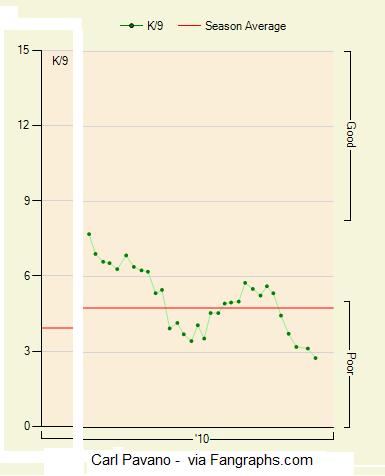
Despite downplaying the significance of the discomfort, the results from August on were brutal. After allowing 131 hits in his first 148.2 innings, he finished the year allowing 96 hits in 72.1 innings including seven home runs post-August. In addition to that, Pavano’s strikeout rate fell off the table:

While it is likely that these results were purely the effects of high mileage on his arm, and an off-season of rest should rejuvenate him, it is still possible that his discomfort in his neck problem leads to something more substantial.
It is easy to go back-and-forth on whether signing Pavano makes sense for the Twins. On one hand, he's 35 years old, ripe for regression and assuming a significant chunk of the payroll. On the other hand, he’s the proverbial “gamer” who works deep into games and racks up innings, alleviating the bullpen’s workload.
When you add it up, for the most part, signing Pavano is a sensible transaction for the Twins. Financially, a two-year contract is reasonable and the $8-to-$10 million per season contract moderate but not outrageous. The biggest downside is whether or not adding Pavano restricts the Twins for making subsequent moves, such as re-signing Jim Thome or adding another quality bench option, or perhaps inspiring them to trade the arbitration-eligible Kevin Slowey to reduce overhead.  
Based on his last two seasons of work, he’s clearly capable of chewing through a large quantity of innings and can work deep into the ballgame. Regression is certainly a probability but given his ability to limit walks, work ahead in the count, get opponents to chase out-of-zone pitches and hit plenty of ground balls, his totals in 2011 should not be too far off from his 2010 season.

Monday, January 03, 2011

A Handful of Predictions for 2011


Seeing as that this new year is just three days old and we are still a month away from pitchers and catchers flying down to the warmer climate to trot off their holiday weight, it is probably very premature to make these predictions. Even so, in no particular order, here are four things I expect to happen in the 2011 season:

Denard Span will be on base more.

After posting his career low on-base percentage in 2010 (.331), the Twins center fielder should be primed to rejuvenate that mark this year.

When pitchers adjusted to Span’s patient approach by buzzing strikes in on the first pitch more frequently, the left-handed lead-off man was often put in debt in the count. This led to fewer walks overall as his rate decreased for the second straight season, lowering from 10.4% to 8.5%. Nevertheless, because of his keen eye at the plate (his 18.5% out-of-zone chase rate is the fifth-lowest in baseball since 2009) and his ability to make contact (90.9% contract rate since ’09, seventh-highest), Span will continue to exercise judicious decision-making in the batter’s box moving forward.

But that wasn’t the only factor towards his reduced on-base percentage.

Span, a habitual line drive/groundball hitter, witnessed his batting average on those balls diminish greatly in 2010. Since more of his batted balls went to gloves in 2010, Span had a fair share of hits taken away from his totals and thus decreasing his on-base percentage.

Batting Average on Balls In Play
2009
2010
Career
Groundballs
.287
.223
.254
Line Drives
.763
.677
.701

In all, this led to a 59-point decrease in his batting average on balls in play, significantly influence his overall numbers. Part of this BABIP decline may have to do with his minor yet potentially impactful alteration with his hand position, bringing the bat closer to his body at the beginning of the year. This led to an inordinate amount of grounders in the season’s first-half. Later in the year, it appeared that Span was getting his hands further away from his body, resulting in more line drives as the season progressed.

As noted above, Span maintains terrific plate discipline skills. Likewise, because of his ability to utilize the spacious center field area at Target Field with a high percentage of line drives, Span is poised to be the catalyst at the top of the order that the Twins envisioned when they signed him to a long-term deal.

Danny Valencia will encounter the proverbial “sophomore slump”.

This one isn’t that hard to foresee. After all, his batting average on balls in play was at an inflated .345 – a hearty fifty points higher than the league average. But that’s not the reason that I anticipate some decline in his numbers.

Often, communication and scouting reports move at various speeds throughout the league. Someone who can’t handle breaking pitches might be discovered immediately and word spreads like wildfire. Other times, certain holes and tendencies are not exposed until after the season. Take Denard Span for example. It took nearly two years for teams to pepper the strike zone early in the count in order to put Span at a disadvantage and it kept him off the bases in 2010.

In Valencia’s case as the 2010 season progressed it became clear that, while demonstrating great plate coverage, he had a soft spot in the zone: down and in.


 Whereas the 2010 season was a dance of trial-and-error for opponents when facing Valencia, as this information gets disseminated through the league, teams will attempt to exploit this weakness while avoiding his strengths in 2011.

Of course, this doesn’t automatically mean Valencia will have a down year, just that he will struggle more this coming season. To be sure, the Twins third baseman has shown that he is a monster when it comes to hitting up and out over the plate. In fact, according to Inside Edge his .203 well-hit average on pitches up in the zone was the second-best in baseball behind teammate Joe Mauer. Unlike some overeager rookies who tend to yank that pitch, Valencia uses the “big part” of the field – hitting 21.3% of balls in play to center field.

Jim Hoey will have a Grant Balfour circa-2008 emergence for the Twins.

Okay, this one is not based on anything remotely scientific, but bear with me on this.
Both Hoey and Balfour are cut from the power-pitching ilk, born from the same lineage that loves lighting up radar guns. Likewise, both had various arm injuries sidetracking promising careers. Balfour required Tommy John surgery in 2005 at the age of 27 while Hoey had his foray with Tommy John in 2004 at 21 years old. More recently, while attempting to correct his career path, a tear in his labrum required additional surgery for Hoey.

In Balfour’s case, the Twins decided to cut ties with the right-handed Aussie after the 2005 season, shortly after his date with the surgeon. He would sign a minor league deal with the Reds only to be selected off the waivers by the Brewers at the end of the ’06 season and rehab in their system. Before being called to Milwaukee, the Brewers shipped Balfour to Tampa for Seth McClung in the middle of the ’07 season. It was there with the Rays in ’08 that Balfour regained his health. That year, Balfour, tossing a 94.6-mph fastball, carved through opponents, striking out 82 in 58.1 innings of work and leading to a very impressive 1.54 ERA.

The savvy Rays front office targeted a talented yet damaged product and received an amazing value as Balfour has become an integral part of the Tampa bullpen the past three seasons.

Minor League Comp.
K/9
BB/9
HR/9
G. Balfour
10.1
3.4
0.6
J. Hoey
10.3
4.4
0.5

Many skeptics question Hoey’s control, particularly given his walk rate in the last two seasons. Certainly, his 5.9 walks per nine innings is un-Twins-like however this is more likely a byproduct of his recovery from labrum surgery as prior to that Hoey averaged just 2.5 walks per nine innings. Like Tommy John, recovering from labrum surgery can be a long, tedious process. Fans may recall Jesse Crain’s road back after a similar surgery in 2007 in which he didn’t appear fully recovered until the second-half of the 2009 season.

If the Twins coaching staff can help him regain his control this spring, Hoey could be a big contributor in the bullpen this coming season and beyond.

Scott Baker will be the second-best pitcher in the rotation.

I know what you are thinking, “If that is true, the 2011 season ended up being an unmitigated disaster”, but hang on. Scott Baker is actually much better than advertised.

Since 2008, Baker has held one of baseball best strikeout-to-walk ratio (3.39 K/BB, 11th-best), showing both the ability to avoid walking hitters and striking them out when necessary. These are the foundations of a very good starter: No walks, high amount of strikeouts.

Of course, that is just a part of the pitching equation, the other part happens when hitters put the ball into play.

Because he likes to work up in the zone and above it, hitters find it easy to get underneath Baker’s offerings. This is why he is a predominately fly ball-type pitcher. This is not a problem in and of itself but there were two factors that influenced his season in 2010.

In 2008 and 2009, Baker had an outfield defense that had both Carlos Gomez and Denard Span behind him. This past year, with Gomez gone, not only did Baker have Delmon Young and Michael Cuddyer covering more real estate in Target Field, when Justin Morneau’s season-ending concussion required Cuddyer to relocate to first it was Jason Kubel who was pressed into duties in right field, further diluting the defensive talent.

This means that more balls found grass and shot gaps than in previous seasons:


BABIP on Fly Balls
2010
.198
2009
.139
2008
.119

To compound the problem, in the middle of the season, Baker revealed that he was having tendonitis issues in his elbow. It was this that likely caused him to drop his release point. With the lowered release point, we see flattening of his fastball and some loss of command in the zone leading to more hard hit balls.

If Morneau returns from the concussion and Cuddyer able to return to his normal position, this should improve Baker’s outfield defense over the assortment at the end of last sesaon. (Of course, platooning in the speedy Jason Repko in Baker’s starts would be an ideal alignment.)  Likewise, since he opted to have a minor procedure in the offseason to correct his elbow issue, Baker will likely return to his pre-tendonitis release point where he had much better command. Together, this should reduce the amount of hits surrendered and leave the 29-year-old righty with his low walk, high strikeout stuff.