Monday, October 31, 2011

Quick Hits: Nathan eyeing the Mets, Madson a Twins option & more Iwakuma


Joe Nathan told reporters during a ceremony for the dedication of the baseball field which will bear his name at Stony Brook University in New York that the Mets “are going to be on my radar”.
Seeing as this was in New York and covered by local reporters, it is only natural that the question regarding the Mets’ closer vacancy comes up. I do believe that his answer is more lip service than a genuine interest in the team. That said, there will be plenty of teams who should have him on their radar as well. His second-half performance suggests that he is capable of providing high-quality work and his recent injury history coupled with his age likely equates to a bargain price (in years and dollars). In the TwinsCentric Offseason GM Handbook, we have him scheduled for a contract for two-years at $7 million per.

In my personal offseason blueprint, I had encouraged re-signing Joe Nathan for the $7M but after more consideration – and depending how the market develops for Nathan – I’m leaning towards giving Glen Perkins a chance as a close and build the bullpen from the bottom up rather than the top down. Perkins has the capability and stuff to be a solid closer and in the small sampling he compiled in 2011, he seemed to work well in high leverage situations (2.83 xFIP). This would save the team $5 million to address other needs.
Regardless of who assumes the closers role, the Twins bullpen needs plenty of attention this offseason - one way or another. 

Newsday’s Ken Davidoff released his annual MLB free agent rankings and predictions. Among them, Davidoff thinks that the Phillies closer, Ryan Madson, will sign with the Twins for a three-year, $27 million contract.
Madson has been a very productive reliever in the Phillies bullpen since 2003 but last season was his first sustained shot at being the team’s closer. He responded well by working in 62 games while posting a 2.37 ERA with a solid 62/16 K/BB ratio. He’s armed with a mid-90s fastball that he complements with a devastating changeup – one that has been baseball’s best since 2009 according the Fangraphs.com’s pitch value (25.3 runs above average). This past season opponents missed on 57% of their swings while hitting just .085 off of it.

He’s a high strikeout, low-walk rate type of reliever that the Twins under normal circumstances would be interested in. The problem is I just do not see the Twins investing three years in to any one for the bullpen. After all, it was one of the reasons (for better or worse) they refrained from re-signing either Jesse Crain or Matt Guerrier at the end of the 2010 season.
Again, similar to the Nathan situation, I believe the Twins would be better served not committing that money to a closer but earmarking that payroll towards filling other needs in the rotation, bullpen and middle infield. 

One potential Twins starting pitching target, Hisashi Iwakuma, made his intentions known regarding his desire to play in the US, saying he was going to “exercise international free agency.”
The Twins have had interest in the 30-year-old Iwakuma as recently as last winter so there will likely be explorations with his agent to see what sort of money he will be looking for. Last year, he was rumored to have been seeking a high sum out of Oakland to which the A’s were not willing to pay. Now, without the hindrance of purchasing his negotiating rights from his Japanese team, Iwakuma figures to make it to the MLB as a B-level free agent this year.

He’s stacked up inning in Japan and completed plenty of games. So if a better option like Mark Buehrle is not willing to leave Chicago, Iwakuma shares a similar profile to Buehrle and could draw attention for other suitors. In theory, he’s got better stuff (including a splitter that has been compared to Dan Haren’s) but it is hard to tell if that will play well on this side of the Pacific as those pitchers making the transition have had mixed results. 

Tuesday, October 25, 2011

Would re-signing Joe Nathan be a good idea for Twins?


The Twins announced on Tuesday that they have officially declined the $12.5 million option on Joe Nathan for 2012. Yet, according to general manager Bill Smith, Nathan remains a very viable candidate to return to the team for 2012, only on a lesser salary:
"I spoke with Joe and his agent this morning, and expressed our interest in re-signing [him]. We will remain in contact with them as we move forward into the free-agent process.”
In the TwinsCentric Offseason GM Handbook, we noted that the closer free agent pool is littered with similar arms to Nathan and we pegged his as the fifth-best among right-handed closers on the market. We estimated that his contract would be approximately two-years, $14 million – a very reasonable rate given his performance record, age and injury history. The question is: Would that be a good investment for the Twins?

Yes, Nathan came back a bit prematurely last year and was cuffed around (a fact that was definitely predicted). From April through May, he worked 15.1 innings, allowed 15 runs on 17 hits and posted a sad 15/9 K/BB ratio. In that time he received swinging strikes on another 8%. That figure was particularly disheartening considering the lowest rate he held since converting to a closer with the Twins was a 12% swinging strike rate.

Because of these results, he went on the DL and then the Twins sent him to Rochester to try to work through some stuff. ESPN1500’s Phil Mackey reported that during his time with the minor league club, Nathan was able to work through some scar tissue that had formed on his elbow, providing him with a great range of motion in his throwing arm. After breaking up the scar tissue, Nathan’s season got back on track. In his final 31 appearances, he worked 29.1 innings allowing only 11 runs and held a significantly better 28/5 K/BB ratio coupled with an opponent average of .193 (not to mention, 11 saves in 12 opportunities). What’s more is that in the season’s final two months, he had increased his swinging strike rate to 11%.

Thanks to dissipated scar tissue, Nathan was able to turn his season around. First, he was able to regain velocity on his fastball:

Joe Nathan’s 2011 Fastball Velocity
Month
Miles Per Hour
March/April
91.3
May
91.7
June
92.6
July
93.0
August
93.3
September/October
91.9
 (via Fangraphs.com)

As you can see, Nathan peaked a bit in August before losing some heat on his fastball. This is perfectly normal. Due to it being his first year back since 2009 as well as the natural bell-curve effect of pitcher’s seasonal velocities, a decline at the end of the season is not unexpected. Still, the improvement in not only his velocity but also his fastball’s effectiveness in the second-half of the year was impressive.

Since he no longer had the build-up on his elbow restricting his motion, Nathan was able to spin his slider – arguably his best pitch – better in the latter portion of the year. 

In the first-half of the season, he struggled to locate the pitch where he wanted it. You can see that visually here:


This scatterplot of sliders resulted in a whiff rate of 13.3% on this pitch. Comparatively, this was a pitch that held a 21.3% whiff rate from 2008 to 2009. Clearly, lacking his velocity combined with a substandard slider, opponents were able to tee up on the pitches they liked instead of fishing for a slider darting out of the strike zone or a fastball above it.

Following his recovery in Rochester, Nathan returned with a much more lethal slider. Over the course of the next few months, he increased his whiff rate to 24.6% while spotting his slider down-and-away from right-handed hitters:


This improved secondary offering complemented his jazzed up fastball which changed hitter’s line of vision much better than in the season’s first-half. The results were more strikeouts and less solid contact.

At 37 years old in 2012, he’s no spring chicken but the progress he made in final three months of 2011 signifies that he is certainly capable of holding down the backend of the Twins bullpen for the next two seasons.

Friday, October 21, 2011

Perkins is worthy of Twins top pitching honor


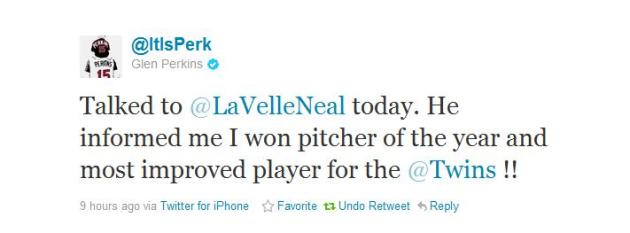
Twins relief pitcher Glen Perkins let the cat out of the bag through his Twitter account, telling the world before the organization could announce it that he was the recipient of the team’s Pitcher of the Year Award in addition to winning the Most Improved Award.


Perkins put together a phenomenal if unexpected season in the bullpen. After injuries eroded his velocity which was hitting 97 miles per hour in 2007 yet had dropped to 89.7 as of 2009, he was suddenly able to dial it back up again – averaging 94 miles per hour on his fastball. With that solid foundation, he expanded the strike zone with his slider leading to one of the best out-of-zone chase rates of the year (37.8%). He posted solid conventional numbers – a 2.48 ERA and 65-to-21 strikeouts-to-walks ratio in 61.2 innings – and according to Fangraphs.com, Perkins finished the year with the 11th-highest Wins Above Replacement among all relievers.  
Without question, his newfound velocity played a significant role in his rebound but it is his slider that was the real weapon. As noted above, Perkins was able to throw his slider out of the strike zone and incite plenty of swings. What’s more is that the majority of those swings on his slider proved fruitless as he held a 40% swing-and-miss rate on the pitch says Inside Edge’s data. All in all, Perkins’s slider was 9.9 runs above average by Fangraphs.com’s measurement. That was the fifth-best among all sliders.
Interestingly enough, it is a pitch that he did not incorporate into his repertoire until he came up to the majors. In 2009, Perkins told Seth Stohs that he was spending time refining the pitch, one that he developed midway through the 2008 season:
I ramped up my offseason workouts and also spent much time talking to people and also practicing throwing my slider.  It is a pitch I started throwing midseason and I am committed to making that a reliable pitch for me.
But it is clear that his success with the pitch goes beyond just being dirty. Perkins simply knows how to use his arsenal. In a sit-down with Upper Deck Report’s Brandon Warne this summer, Perkins outlined a scenario which explains why he has been so dominating against hitters, particularly when using his slider:
“I find that I’ll throw a fastball or two, and if they’re late, I know that I can throw a slider and that they’re going to have to cheat to try to hit the fastball, and before they can stop themselves, they see it’s a slider. That’s been the thing for me, mixing the fastball and the slider, and throwing them at the right time, whether it’s starting with the slider or finishing with the slider. Throwing those pitches at the right time and recognizing what the hitter is trying to do, and using that to my advantage has gone really well for me.

The other day, McGehee was late on two sliders, and I threw three more. Two were bad, and then the third one was down-and-in where I wanted to put it, and he swung over it. He was probably cheating on the fastball, and had to get his hands ready. It was a situation where I recognized what he was trying to do, and went the other way. I think that’s as much as anything like command, velocity and movement, is trying to realize what a hitter’s trying to do to you, and adjusting from there. But obviously, the harder you throw, the easier those things are to do.”
Here we see that aforementioned slider he threw to the Brewers’ Casey McGehee:
What we see is excellent location of his slider, placed in a spot where a hitter can do nothing but flail over the top of it. Because McGehee is cheating fastball, he is expecting the pitch to be a knee-high fastball and commits to swinging. Halfway home, the bottom drops out on the ball and it darts towards the ground, leaving McGehee unable to hold up his swing.  The Brewers’ infielder is not the only one to fall victim to this approach as Perkins had K’d nearly 30% of right-handed opponents faced – a remarkable rate for a left-handed pitcher.
As analyst try to make sense to Perkins’ meteoric rise in the pen, some wanting to believe it was a fluke or the product of a small sample size, being healthy, developing a deadly slider and having keen understanding of his opponents has propelled his 2011 season. He has become a pitcher, not just a thrower.
Perkins is one player the Twins will need to make a decision on this winter but the decision shouldn’t be too difficult. He is arbitration eligible and his salary figures to double however the $1.8 million we have estimated in the TwinsCentric Offseason GM Handbook is a very reasonable cost for a dominating relief pitcher. On the free agent market, his service may have been twice that over three years. So, while the rest of the bullpen personnel remain a mystery, Perkins will be a fixture in the ‘pen come spring. 

Tuesday, October 18, 2011

Any hope for Nishioka?


In his conference call to the season ticket holders, Twins general manager Bill Smith made no promises for last offseason’s marquee signing, Tsuyoshi Nishioka:
"We've gotta figure out shortstop, and that may involve going out and getting another shortstop. We've got [Alexi] Casilla, we've got [Trevor] Plouffe, we've got [Tsuyoshi] Nishioka -- we've gotta find somebody that can be a stable, starting everyday shortstop."
So, the man they were willing to commit $9 million to over three years is now destined to try to earn a job in the spring. For the majority of fans, this suits them just fine. Better yet, he can go hang out with the center field trees – wherever they are now.

When he was initially signed, I broke down some of the available footage of Nishioka’s Japanese playing days. At the time, I caution that the video clips, compiled by Beverly Hills Sports Council (also Nishioka’s stateside agent), were very likely cherry-picked to serve the purpose of inflating his value. Even with this in mind, the majority of his swings seemed impressive as the ball was jumping off his bat. Yes, he pulled off with his front hip on the left-side but overall, Nishioka was driving the ball on a rope to all fields. The thought was that his foundation seemed solid enough to support a somewhat smooth transition.

Of course, the transition was about as smooth as Stearns County bathtub whiskey.

Truthfully, I was a bit stunned at what showed up in a Twins uniform. This version of Nishioka resembled nothing of the player that was poking line drives every which way but loose.

Early in the season, he struggled to stay in with his front side while batting left-handed and opponents picked him apart by pitching him away. He constantly made weak contact. In fact, his .014 isolated power average was the lowest against right-handed pitching in all of baseball (among those with a minimum of 130 plate appearances). According to Inside Edge’s scouted data, they have Nishioka marked with a .135 well-hit average against righties – lower than Drew Butera and Rene Rivera.

When Nishioka was finally shutdown in September for the year, manager Ron Gardenhire provided his assessment of how to better the Japanese middle infielder:
"His upper body is not as strong as I think it can be. He can gain upper-body strength, and that is going to help him with his swing. Perry has a good program written up for him, and I know Nishioka [already] has a good program over there."
While adding upper body strength is a good thing (so long as he doesn’t focus too much on his glamour muscles), Nishioka’s problems at the plate seem to stem from his legs, not his arms. Take a look at these two side shots of his swing from the left side, one from his Chiba Lotte days and one from this past season against New York:


There is a noticeable difference that stands out to me which may be a source of his offensive incontinence as a lefty - his launching point. The launch point is when a hitter’s weight is shifted back before he launches forward towards the pitch. Let’s take a look at some of Nishioka’s swings from the left-side throughout the years:


In the first clip, an image of him from the ‘06 NPB season when Nishioka was a 22 year old in his fourth year of professional baseball, you see him implementing a very aggressive leg kick and in position to drive his front leg forward.


In the second clip –one from Nishioka’s latter Chiba Lotte days – we find that the launch point is scaled down a bit. Still, what you see from this position is that Nishioka is driving his front hip forward as a significant amount of his weight is poised on his back leg.


Meanwhile, this year, Nishioka seems to have once again refined his mechanics and reduced the amount of lift in his front leg (or at least varied the angle in which he brings his front leg back). He also is shifting less weight on his back leg thus staying tall more throughout his swing. The end result appears to be more arm and wrist in his swings than engaging his lower half and weak contact overall.

Now, to speculate, there are plenty of reasons why Nishioka would pare down his stride. The first being due to the increased velocity in America versus Japan – simplifying his swing would aid him in making more contact. The aggressive approach would also leave a hitter more vulnerable to off-speed pitches as well. Perhaps he made the adjustments on his own.  Another theory is that the Twins encouraged Nishioka to trim down his lower half for the same reasons listed above. The club prides itself on putting the ball in play and may have wanted Nishioka to focus on contact and using his speed (or rather the once projected speed). Regardless of the why, it has made Nishioka one of the worst offensive producers the Twins have seen in a long time.

Ideally, for someone like Nishoka, more effort is needed from his legs and hips in order to generate some semblance of pop. This is very similar to Alexi Casilla. Dating back to 2010, Casilla had a pared down swing from the left-side, relying mostly on his upper body to do the work. Unfortunately, this resulted in more bouncers and slow rollers than anything else. At some point, Casilla incorporated his legs more and he had much more success:
“Casilla is able to engage his lower-half much better. Because of that, despite putting plenty of balls on the ground, we see the ball jump off his bat much better than it had at the beginning of the season. So, while grounders still become outs at high percentage of the time, putting them into play at a greater velocity is bound to turn into hitters more frequently than those of the slow bouncer variety.”
So, is Nishioka hopeless? Did the Twins just piss away $9.25 million in salary and another $5.3 in securing his negotiating rights?

One winter ago everyone assumed Casilla was cooked. His small adjustment proved that he could compete, posting a 779 OPS from mid-May until his mid-summer injury. Looking back at the old footage of Nishioka, I can see him capable of having a much improved season in 2012.

Without touching upon the atrocious defense – that’s a whole ‘nother problem right there – if the organization hopes to salvage some of the investment spent on Nishioka on the offensive side of the ball, the focus should be on getting him to return to his pre-major league days. 

Friday, October 14, 2011

Twins targeting another player from the Far East?


In his recent Star Tribune chat, Joe Christensen speculated that the Twins would target free agent pitcher Hisashi Iwakuma this winter:


Christensen’s statement may be based on some internal rumblings or it may be a residual of the Twins pursuit of him last offseason. Last winter, the Twins came in a distant second to the Oakland A’s for the rights to negotiate with Iwakuma and his agent. Minnesota offered $7.7 million to the Rakuten Golden Eagles but was thwarted when the typically miserly A’s submitted a bid of $19.1 million.  

After Oakland secured the rights, the negotiating part took a wrong turn for the Bay Area organization. According to reports, Iwakuma and his agent were seeking a “Barry Zito-like” contract (seven-years, $126 million) while Billy Beane went all Moneyball on them and offered a four-year, $15.25 million deal. Unable to work out a deal, Iwakuma went back to the Golden Eagles for the 2011 season.

Iwakuma, now an outright free agent this winter negating the need for a posting fee, has hired a new agent and figures to be one of a handful of talented pitchers on the market. Outside of CC Sabathia and CJ Wilson, Iwakuma likely falls in the same category as Edwin Jackson and Mark Buerhle (minus the experience). If he prices similarly to those two, he could be looking at a contract worth $8-to-$11 million per year.

The 30-year-old right-handed pitcher has some legitimate sink which would incite plenty of ground balls. Like the rest of the Twins’ cadre of pitchers, he fits the bill as a pitch-to-contact type with his 89-to-92 mile per hour sinking fastball. He comes equipped with a variety of pitches and speeds, using a curve, slider, splitter and a shuuto. The results in his Nippon career have been solid – a career 3.25 ERA with a 107-69 record while strikeout out 18.4% of batters faced.

Pitch F/X wizard Mike Fast broke down Iwakuma’s 2009 World Baseball Classic performance and found that the majority of his offerings were about average but that he had an above-average splitter:
“His split-finger fastball averaged 86 mph, and he got three inches of hop and eight inches of tail on the pitch due to spin.  Adding in the effect of gravity, the splitter dropped about nine inches relative to his four-seamer.  He threw the splitter 31 percent of the time to left-handed batters and 20 percent of the time to right-handed batters. It was his main strikeout pitch, accounting for five of his nine strikeouts in the last three games of the WBC.  Batters swung and missed at 34 percent of his splitters, which is an excellent mark.”

With that vast repertoire and an out-pitch like his splitter, his ceiling could be like that of the Angels’ Dan Haren, who has average velocity but throws a variety of pitches and has a devastating split-finger fastball.

The question is: Would he be a good fit with the Twins?

Without a doubt, the Twins need to address the depth of their rotation. Last year’s team floundered when several members were sidelined over long periods of time (Baker, Blackburn and Liriano) and were hurt even further when those who were expected to perform simply did not (Liriano and Duensing). This put a lot of stress on a weak bullpen. In theory, Iwakuma, who has worked deep into games in Japan, throwing 48 complete games in his career, would be a decent solution.

But that doesn’t necessarily make him the ideal solution either.

The second concern is regarding targeting another pitch-to-contact arm. While I have no qualms with the method, it only works provided the right infrastructure is in place. Last season showed that when the infield defense is substandard, those types of pitchers who allow balls to be put into play suffer heavily. If the team is not willing to upgrade defensively around the diamond, pursuing an arm that is capable of missing bats is likely a better investment at this point.

Finally, how much does the Twins front office trust their scouting staff when it comes to pulling talent out of Japan? The ballad of Tsuyoshi Nishioka should already give them pause. Sources say that the scouting department was none too thrilled by Nishioka’s skills overseas but yet the staff signed off on his ability before handing him a $9.25 million deal. Would they actually return to that well so soon after Nishioka’s disastrous year?   

In the end, the Twins will likely be looking for another starter and Iwakuma will be a name you hear repeated again this offseason.