Monday, May 02, 2011

OtB Twins Notes: Pavano's problems, Liriano's release point, baserunning and more


Following being pulled from the game on Sunday with a 6-2 deficient and in line for his third loss of the season, starter Carl Pavano went all Red Ross in the dugout with an unfortunate baseball bat.
While it may be interpreted by some as a childish act of frustration, Pavano demonstrated that there is some passion left on the team as it finishes April in a nasty tailspin.

Part of Pavano’s personal problems extend for a noticeable decline in ground balls (dropped from 52% to 43%) and a hike in walks allowed (up from 1.5 BB/9 to 2.8). Also, after leading baseball the past two seasons with inciting the most out-of-zone swings, he has regressed in this area too, now down to 27%, below the league average. (It should also be noted that his overall zone rate has fallen as well.) For Pavano, who is not to be mistaken as a strikeout pitcher, this represents somewhat of an issue. What this means is opponents aren’t fishing for those off the plate pitches, bouncing into grounders and are much more likely to take a walk.

It might be that opposing teams have figured out his approach. Considering Pavano has been one of the premier pitchers at getting strike one, it is not surprising to see that hitters this season have teed off on his first pitch. Heading into yesterday’s game, opponents have gone 8-for-16 (.500) with a double and a home runs (.875 slugging) but have little success in other counts.

Following Friday’s game, Ron Gardenhire lamented the team’s overall baserunning, particularly Danny Valencia’s inability to second from second on Rene Tosoni’s single and Tosoni not moving up to second on the Royals misplay. This eventually led to a refresher course on base running on Saturday.
According to BillJamesOnline.net’s accounting system for team base running, the Twins are -6 run below average on the base paths. While that number is far from the worst team (that honor goes to the Los Angeles Angels at -22), the Twins’ redemption is there impeccable stolen base rate (100%) given them a better number than they likely deserve.

Consider this: In the situations described by Gardenhire in the article – failing to score from second – the Twins have failed miserably this season. Dating back to 2002, when the Twins had a runner on second and an opportunity to score, they did so 60% of the time. This season however, they have had 31 opportunities to score from second but successfully converted just 9 times (15%). Without much in the way of power, the offense needs to become more aggressive on the bases in those situations in order to score runs.

In efforts to straight out Francisco Liriano, the Twins coaching staff apparently showed him “diagrams” to show that his release point is off.
As someone who is fond of using data, I’m genuinely curious to know what these “diagrams” showed.

My first thought was ‘have the Twins decided to use Pitch F/X?’ If they did, I’m not certain that there is enough evidence to support that his release point is any more or less inconsistent from last year. He moves all over the rubber and has a release point that drifts in a wide array. Furthermore, Pitch F/X doesn’t necessarily show where the ball was “released” but rather it picks it up a few feet from where the ball leaves the pitcher’s hand (it can provide some insight but this needs to be considered when analyzing the data). So I doubt that they wound up using Pitch F/X info.   
From researching last Friday’s TwinsCentric post on Liriano’s inability to keep his fastball down, I mentioned that he is finishing higher in his mechanics and thus the ball has a higher likelihood of remaining up in the zone. It seems to have plenty of overlap in what the Twins were attempting to show Liriano and – while the team may be miserable to watch right now – I’ll be looking for any changes in this area following Tuesday’s start in Chicago.

Speaking of mechanics, Justin Morneau’s swing has been off this season. He has been opening up far too much and pulling out with his upper body resulting in turning over a pitches middle-away rather than drive those offerings to center like he did a year ago.
On Friday, the Royals were able to pick this flaw apart. In fact, Kansas City was so confident in their ability to retire Morneau, that they left right-handed reliever Blake Wood in to face him while the tying runs were on second and third in a 3-1 game. Wood struck him out and stranded the two runners. In general, Morneau’s swing looked awful as he pulled off on every pitch. According to Ron Gardenhire, Morneau has been working hard in BP to correct this and his homer on Sunday may be early signs that the hard work is paying off.
Are we seeing a much better Denard Span in center? According to John Dewan’s Plus/Minus fielding system, Span is currently the top rated defensive centerfielder at +11.
Take it with a grain considering defensive metric need a large sample size to read accurately, however Span has seemingly played with a bit more confidence in his second season in center. At Fangraphs.com, Span is the only starting center fielder who has successfully converted all of the balls in his zone into outs leading to a baseball-best 1.000 revised zone rating. Additionally, he has tracked down 16 more balls out of the zone for the fourth-best mark in MLB.

Last year, there were numerous incidents of Span deferring to his neighboring outfielder instead of tracking the ball himself. This season, he has seemingly taken charge as the captain of the outfield and has aggressively pursued flies.

Filed under former Twins members: Now with the Padres, Orlando Hudson is nine-for-nine in stolen base opportunities and is tied for second in the National League in that category.

While there were plenty of undertones regarding his clubhouse presence in addition to his soaring earning potential that possibly led to Orlando Hudson not returning to the Twins after the 2010 season, the message sent by the front office was that the team need more speed in the lineup. According to Twins general manager Bill Smith back in March:
"Hardy and Hudson did very well for us. They helped us win another division. When we went with them, we lost team speed. That was one thing we were looking to add. If we can get Casilla and Span and Nishioka creating havoc on the bases, then have the bombers coming up behind them, we're going to score a lot of runs." 
Offensively, Hudson is struggling some at the plate but getting on base at a decent enough clip and is managing to provide that “havoc” for San Diego. While at an age where long-term contracts would be ill-advised, perhaps the team’s assessment of his speed potential was slightly misguided.

This attempted throw back to Alex Burnett from defensive wiz Drew Butera during Sunday’s game epitomizes the Twins season thus far.

Friday, April 29, 2011

Answers for Liriano's rough start?


It has been said that great expectations often lead to greater disappointments. Through his first five starts of the season, Francisco Liriano could not be doing a better job epitomizing that sentiment if he tried.
Blessed with tremendous raw stuff, enough so that many wonks figured he could easily compete for a Cy Young award this season, Liriano has struggled mightily once again with his command, making his outings as enjoyable to watch as some useless British wedding. In 23.2 innings of abuse, Liriano has posted a disappointing equilibrium of 18 walks and 18 strike outs. In his first five starts last year, Liriano had tossed 36 innings with a solid 36-to-13 strikeouts-to-walk ratio and a miniscule 1.50 ERA. What’s more is that he has already been touched for four home runs, a total that wasn’t reached until September 7 and required 27 starts to get there.
This year? His peripherals are bad, there’s no solace in his fielding independent numbers, and he can’t find the strike zone.
Naturally, Mother Nature was a miserable wench during his most recent start, sharting snow pellets at the field and making conditions wretched for pitchers nevertheless, Liriano abided and was cuffed around by the hot-hitting Rays lineup and was excused from the bitter cold have three innings and 83 pitches.
After the start, the now 1-4 Liriano tethered to a 9.13 ERA gave reporters a self-diagnosis for his woefully start to the season:
"I've got my confidence back. I'm just missing my spots. Just leaving the ball up in the zone. Tonight was a cold night -- not fun to go out and pitch in that weather.”
Unequivocally, Liriano’s success starts with his fastball. When he is able to throw it over for a strike on a regular basis, it sets up his slider and change-up. So far this year, Liriano has struggled mightily to throw his fastball over the plate but moreover, when he does, it typically is his fastball that is hanging out there for opponents to slap around.
While Liriano was never a zen-master of control over his heater last year, he still maintained a respectable ability to get it over for a strike. That likelihood has plummeted hard:
Liriano’s fastball command
 
Strike%
2010
63%
2011
54%
 
In addition to owning the league’s lowest strike rate with his fastball, he also has the second-highest well-hit average (.385) on the pitch as well.
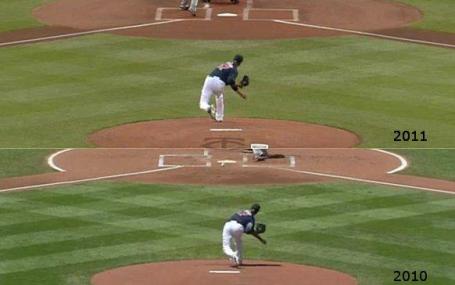
Scouring the video archives, there seems to be a small yet critical difference in his delivery that could possibly be the source of his inability to get the ball down. In the first video from 2010, Liriano dials up a fastball to this particular right-handed hitting Ryan Spilborghs:
 
Focus on Liriano in the clip after the release. During his follow through, he has a significant amount of bend in his back when finishing, helping keep his offering low in the zone.
Compare that to Wednesday’s delivery:
 
In this fastball to Tampa’s Sam Fuld, Liriano remains more upright after his release, not finishing with the same downward action. The result was a pitch that wound up belt-high instead of knee-high and crushed to the furthest depths of Target Field. This is a trait that was shared among several of the other clips from his previous starts this year.
Here is a still-frame:
As you can see, the 2010 version has slightly more bend helping drive the ball down. Again, it is a seemingly tiny difference however it could be the distinction between a knee-high fastball and a belt-high one.
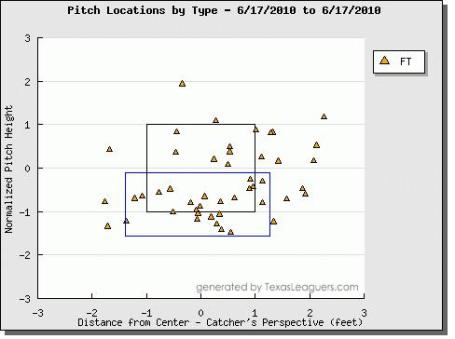
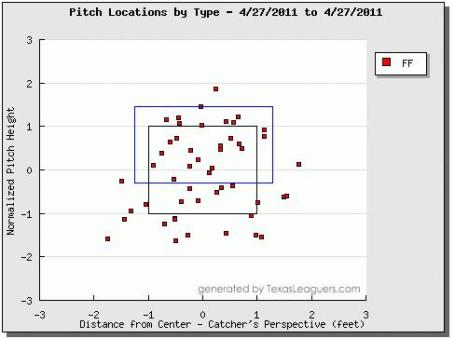
How influential can that minute factor be? Take a look at the locations of Liriano’s fastballs from those two outings:
Here we can say that the bulk of his fastballs feel into the knee-high category. Once again, there are plenty of stray bullets around the strike zone but a vast majority finished low.
Liriano’s fastball placement on Wednesday was haphazard at best with a sizeable amount finished up in the zone and over the middle of the plate.
Why is the difference in Liriano’s delivery? I don’t know. Certainly there could be a nagging back injury influencing it but the more likely scenario is that Liriano is still attempting to re-establish the feel for his mechanics after a long winter away from baseball. When the Twins refer to his “inconsistent mechanics” this is probably just one of several glitches they would like to smooth out.
It goes without saying but if Liriano wants to return to his 2011 form, he’s going to need to locate his fastball in the lower half of the strike zone on a more consistent basis. My guess? Straight out this hiccup and we will start seeing him throwing hard at the knees once again.

Friday, April 22, 2011

Kubel's adjustments pay early offensive dividends


Last April, Jason Kubel was probably extremely interested in locating the reset button.

After all, through the season’s first month Kubel was hitting an anemic .219/.352/.329 (BA/OBP/SLG). At that time, opponents relegated themselves to throwing a vast majority of junk and off-speed pitches up at the Twins DH the season’s initial month. This came on the heels of him lacerating fastballs all over the Metrodome so it’s no small surprise that team adjusted.

This April, outside of Denard Span, it’s not hard to say that Kubel has been the focal point of the Twins offense. Heading into Thursday night’s game, the left-hander was pacing the lineup with a .323/.362/.492 batting line. Beyond that, Inside Edge has identified him as one of the top ten American League hitters at putting the ball into play well:

Player
Team
Well-Hit Average
Matt Joyce
TAM
.377
Miguel Cabrera
DET
.364
Sam Fuld
TAM
.344
Maicer Izturis
LAA
.329
Edwin Encarnacion
TOR
.327
Billy Butler
KCR
.323
Mark Teixeira
NYY
.310
Curtis Granderson
NYY
.309
Jason Kubel
MIN
.308
Brian Roberts
BAL
.302
Via MyInsideEdge.com

In the simplest terms, what this means is Jason Kubel is swinging the bat very well. Let's take a look at his swing mechanics and see if there is a difference in the way he is approaching the ball:


Two things I see right away with Kubel’s swing mechanics:

(1) He has opened his stance up and (2) lowered his bat angle before his swing.


Addressing the latter first, in Kubel’s 2010 swing, the first movement his bat made was downward once the pitch was on the way but then it popped right up again. On the other hand, his 2011 swing quiets that but simply popping up and then driving towards the ball. But, as you can see in a side-by-side comparison of last year, what stands out the most is that Kubel has opened up his stance...again.

When the Twins drafted Kubel out of his Palmdale, California high school in 2000, he had an opened stance with considerable pre-swing bat movement. Back in 2004, the year he had his first taste of big league play, prior to being hindered by various leg maladies which stunted his development, the powers-that-be attempted to dissuade him from using the opened stance. That year, Jim Dwyer, the team’s minor league hitting instructor, had him close his stance.

It’s hard to argue Dwyer’s teachings considering the results Kubel posted. In that year, in 150 games split between New Britain, Rochester and a September call-up in Minnesota he hit .347 with 24 home runs. By closing his stance and getting him to quiet his pre-swing bat movement, the Twins helped Kubel become one of the game’s best potential offensive threats – leading Baseball America to rank him as the number 17 overall minor league prospect.

For a spell, this did just fine for him. From 2006 to 2009, he hit .277/.339/.476 and become a powerful middle-of-the-order presence for Ron Gardenhire’s team. But perhaps the fallout of having such a rough introduction into the 2010 season coupled with the new home field’s overwhelming need to pull the ball coerced Kubel and hitting coach Joe Vavra into re-examining his approach at the plate. After all, the opened stance allows a hitter to see the ball more, hopefully identifying the spin of the off-speed pitching quicker and more readily – a practice that seemed to evade him last year.

This approach also has a recent history of helping other lefties too. When the Yankees’ hitting coach Kevin Long went to revamp the left-handed hitting Curtis Granderson’s approach during the playoffs last year, Long opened up Granderson’s stance to help him see the ball better. Clearly, Granderson has continued to rake since this adjustment as he is currently just ahead of Kubel in the well-hit average category so far this year.

It goes without saying that as Joe Mauer. Justin Morneau and Delmon Young remain sidelined with various ailments, if the Twins expect to gain ground against the surprising leader of the AL Central this weekend, the team need individuals like Jason Kubel to step up and maintain this pace until reinforcements arrive. Given his new approach and the early returns it has brought, watch for him to be a big factor in the upcoming series against the Indians who have three right-handers on the mound. 

Sunday, April 17, 2011

Nathan's slider could use some work


The sobering reality set in on Saturday afternoon when Joe Nathan blew his second save opportunity in as many tries, forcing Ron Gardenhire to strip him of the team’s ceremonial position of closer.

Overall, the numbers resembled nothing from his pre-surgery performance. Whereas pre-Tommy John Nathan was one of the game’s best relievers, demonstrating a well-balanced repertoire of equal parts precision and power, the post-op Nathan has failed to get ahead of hitters, unable to get them to chase much out of the strike zone and miss any bats:


First-Pitch Strike%
Contract%
Chase%
Swinging Strike%
2008
63.6
70.0
30.3
14.0
2009
63.8
68.7
32.9
14.8
2011
48.2
90.7
20.3
4.6

This led to an increase in walks, hits, base-runners, Johnny Damon-walk-offs-and-celebrating–in-only-the-douchebaggery-way-he-can and disappointment among the coaching staff when Nathan has been unable to solidify a Twins victory.

Despite issues with his ability to command all pitches across the board, according to Tom Pelissero of 1500ESPN, Gardenhire attributed most of Nathan’s reduction in whiffs to the lack of bite on his slider, his once-premier pitch:
"It's that slider that's not snapping like it was, and that's the one he used to get people to swing and miss at an awful lot. Now he's kind of gone to a little bit of a curveball, because his slider is still not there yet. And that's probably par for the course with the elbow thing like that."
As I discussed at the beginning of the month, Nathan’s slider is his money-maker. Just look at some of his numbers he put up when using the pitch:
“According to Inside Edge's data, from 2007 to 2009, opponents managed to hit just .163/.205/.234 (AVG/OBP/SLG) off of his slider. Twins infielders would regularly get a quick breeze in their directions as opponents swung-and-missed a whopping 40.8 percent of the time when taking a cut. For Nathan, his slider was his go-to out-pitch racking up 122 of his 242 strikeouts on it. When hitters did make contact, the slider was typically kept on the ground – a stark contrast to his fastball which they tended to elevate.
Comparatively, while only throwing a couple of handfuls of sliders this season, the results on the pitch have been atrocious:

Joe Nathan’s slider performance

Well-Hit Avg.
In Play%
Chase%
Miss%
2009
.138
26.0
45.0
44.0
2011
.443
60.0
11.0
10.0
League Avg
.131
36.4
30.5
31.0
       (MyInsideEdge.com)

There are some schools of thought that suggest a bad slider is worse than almost any other type of bad pitch. According to an article from The Sporting News dated back in 1994 (is it still okay to cite something written when Ace of Base was topping the charts?) discussing the topic, where a hanging curveball has the advantage of having a gap in velocity, a bad slider is thrown on the same plane as a fastball and comes in at near-identical velocity. In Nathan’s case, where the ’09 slider had a six mile per hour differential from the fastball, since then just three miles per hour separate his slider from his fastball.

Using pitch f/x we see two realities of Nathan’s pre-Tommy John and post-Tommy John sliders. The first is that, on average, his slider isn’t finishing down in the zone as it did in the past. According to data found at pitchfx.texasleaguers.com, Nathan’s movement on his slider isn’t witnessing the same amount of vertical spin as it did in the past:

Joe Nathan’s slider movement

Vertical
Hortizonal
2009
2.29
1.17
2011
4.43
1.79

To better understand those numbers, the first column represents a measurement in inches of how much, on average, the pitch moves downward. More simply: the lower the number, the greater the drop. The second column represents the east-west movement. As the numbers increase away from zero and the negative numbers, this means the pitch is moving towards the pitcher’s left – or in at a left-handed batter. Knowing this, we can glean that Nathan’s slider has reminded up in the zone more frequently this year thereby confirming Gardenhire’s statement regarding a lack of bite. In essence, his 2011 slider is remaining closer to the same vertical plane as his fastball.

The second thing that pitch f/x data shows us is that, on average, Nathan’s release point on his slider has sank somewhat:


This lil’ factoid is likely the root cause of Nathan’s loss of vertical movement.

What this shows us is that in 2009, Nathan demonstrated a greater ability to stay on top of the baseball when chucking his slider. By staying on top, he was able to gain downward movement rather than an increase in horizontal deflection. This season - possibly because of the extended time off or simply because of the re-built elbow - Nathan’s slider release point has been lower compared to his ’09 outings and with it his slider has remained up in the zone.

Without question, it is easier said than done telling someone to stay on top of a pitch – particularly when there are physical influences such as a new elbow factored in. However, while demoted down the ranks of the bullpen and consuming low leverage innings, in those outings Nathan should be very conscious of where he is releasing his slider and attempt to rediscover that release point. 

Wednesday, April 13, 2011

What's behind the offensive plight?


A year ago, the Twins fairly high-octane offense generated 4.8 runs per game in their first 10 games played. This season, the Twins sputtered out of the gate averaging two full runs fewer in the same amount of games. Let’s take a look at some of the reasons behind this scoring decline:

(1) No free passes

This year’s model has been unable to remain patient and selective – at least in contrast to last year’s team. In their first nine games, the lineup has managed to draw just 22 walks – the fewest in baseball. In comparison, through the first ten games last season, the team had coaxed 43 free passes off opposing pitchers. That’s 21 fewer base runners by virtue of walks alone.

This appears to be the byproduct of pressing. As the season progresses, hitters are compounding their issues at the plate by attempting to hit their way out of the doldrums. Only, we often see hitters stretch out the strike zone and put borderline pitches into play – frequently to the pitcher’s delight. Being more discriminating at the plate will lead to more base-runners and an inflation of a starter’s pitch count.

(2) Not capitalizing on favorable counts

This drought may lead one to believe that opposing teams are thundering hellfire and strikes across the plate however teams are actually avoiding the strike zone like the plague against the Twins. Minnesota has seen a very low number of first-pitch strikes to date (55.6% vs. 59% league average) and the seventh-lowest zone presence (46.2% vs. 48% league average). In theory, this should lead to favorable counts for the offense – one in which hitters can drive the ball or coax a walk -- yet those opportunities have been squandered.

When hitting ahead in the count, the 2010 Twins batted a robust .303/.473/.486 – slightly above the league norm under those circumstances. This year’s team is hitting nearly two hundred OPS points below that benchmark with a .250/.373/.384 line when ahead in the count.

In the recent broadcasts, Bert Blyleven stated that he believed opponents were pitching the Twins hitters’ backward more – that is, throwing more breaking and off-speed pitches during typical fastball counts. Observationally, this makes sense. I’ve witnessed several accounts when this happened, catching a hitter way out in front of the pitch when they expected something harder. Scientifically however, I am a tad more skeptical if this truly is the case. Without being able to pull pitch f/x data for the entire team on my own, I cannot corroborate or disprove Bert’s theory. At this point, let’s leave it as the Twins are not producing at the rate they did last year under the same conditions.

 (3) Not driving the ball to the opposite field

From 2008 to 2010, the Twins blasted their way to the plate by driving the ball the other way. Sure, it may be an approach that David Ortiz thinks makes you “hit like a little bitch”, but it worked for the Twins. In that duration, the team amassed a .330 wOBA – the best in baseball. They piled up 1,226 hits when going “oppo” (the most in that time) as well as 296 doubles (also the most). This season, they’ve shown little pop going the other way. While they are struggling to get hits to all fields, they have a muddling .252 wOBA with just two extra base hits.

This stat is more of a barometer to fundamentally how the team is hitting. When you see numerous opposite field shots, you know that the hitters are sitting back and driving pitches outside. When you see the number of hard-hit opposite field balls drop, there is likely a rise in pulled groundballs as hitters tend to turn over on those pitches away.

With a park that plays big like Target Field does, you will likely see opposing teams implement the same strategy the Royals’ Jeff Francis did on Tuesday night and that is destroy the outer-half of the plate. Hitters are not likely to drive that pitch to the opposite field for a home run so damage will be minimal in a worst case scenario. In the best case, the opponents simply roll their wrists over and put the ball on the ground. The Twins hitters need to show they can drive that pitch with consistency to the opposite field where they have demonstrated success in the past.

*****
On Tuesday, April 19th, Lindsay Guentzel (the former “Intern Gal” at KFAN) is hosting a benefit for The Leukemia & Lymphoma Society at Bayside Grille in Excelsior. In additional to watching the Twins take on the Baltimore Orioles, there will be food & drink specials along with drawings & prizes (I’ve got some DiamondCentric shirts and pint glass to giveaway) all supporting a terrific cause. Please come out to the Lake and join us!