Friday, November 12, 2010

Move the fences in or let hitters adapt?

The Twins recently announced several adjustments to Target Field for 2011 but apparently they missed an opportunity to appease one of their biggest sluggers. According to Joe Christensen and LaVelle E Neal, Justin Morneau told them that he had lobbied to team officials to move the fences in from right-center to left-center field.
"Right-center to left-center is ridiculous. [It's] almost impossible for a righthanded hitter to [homer to the] opposite field and very difficult for lefties. It affects the hitters a lot, and you start to develop bad habits as a hitter when you feel like you can only pull the ball to hit it over the fence. You take those habits on the road."
Of course, I’m certain if you asked the pitching staff, they would have the exact opposite opinion.
This request echoes that of then-Detroit Tiger Juan Gonzalez’s demand to have the newly opened Comerica Park’s fences brought in. At the time, the Tigers’ home field had a power alley in left field 398 feet from home plate with a distance of 365 down the line. Gonzalez had one of the worst seasons of his career and left for Cleveland the following year as a free agent. The Tigers have since moved in the configurations, shorting the distance in the power alley to 370 and moving the left field corner in to 345.
The Mets, who play at the power-detracting Citi Field, have also toyed with the idea of moving their fences in (by moving home plate closer). Also noted, plenty of other teams over baseball’s history have made alterations to their home fields, including the launching pad of USCellular Park in Chicago, who moved their fences up in 2001.
Morneau wasn’t the only left-handed hitter to notice the need to adjust to hit a home run in Minneapolis. Jason Kubel had moved up on the plate during a home series against Milwaukee in hopes of achieving more power. After hitting three home runs and not much else, Kubel went back to his old style. Right-handed hitting Delmon Young admitted he stopped trying to hit the ball to the opposite field at home. After their series in May, the Yankees Nick Swisher told Pat Borzi this:
“You’ve got to be a grown man to hit it out of there. I’ve got to go down the lines, you know?”
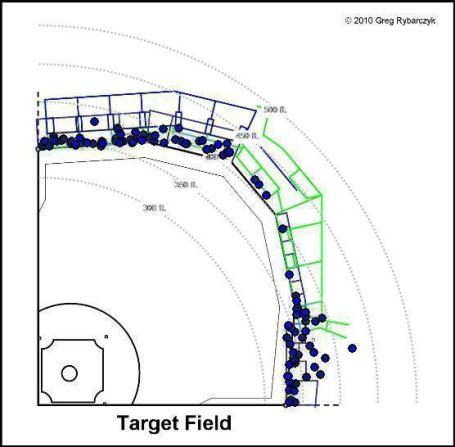
To be sure, Morneau’s assessment has been correct. That is one cavernous area of land out there which is further amplified by the wind effect that has been pushing balls back towards the playing surface. Using spray charts supplied at HitTrackerOnline.com, we can see that just five of the 116 home runs hit at Target Field escaped the clutches of the field in that direction all season:  


There is an element of hitters learning to adapt to the playing surface that you call home. In a recent article in Baseball America by columnist Tracy Ringolsby, Atlanta’s Chipper Jones had made comments regarding the advantage Rockies players have at Coors Field. This incited Ringolsby to rehash a 1984 story of George Brett. Brett’s Royals had been playing the Detroit Tigers in the Championship Series and Brett was asked if he liked Tiger Field’s layout with the short right field porch.
Brett replied:
“I’d probably have had a Darrell Evans type of career, hitting 40, 45 home runs a year with a .260 average. The reason I became the type of hitter I am is because of Royals Stadium. As a hitter, you adjust to your home park to take advantage of what it has to offer. Remember, you play 81 games a year, half your schedule in that park.”
Morneau went on to note that the team had been built for power and offense, which the home park stymied in someways. Of course, gap hitters like Denard Span flourished in the spacious field. After witnessing the park’s home run-thwarting abilities, rather than change the physical surroundings, the team may consider swapping some of the personnel. This fact may validate the need to find speed over power as Bill Smith alluded to earlier in the off-season.
In the end, Morneau’s comments are warranted. Of course, it doesn’t mean his (and other teammates’) demands should or will be met. Nor does it appear that the Twins sound willing to accommodate in the near future.
If that isn’t good enough for the Canadian slugger, I guess there is always the new clock in right field to count the minutes remaining on his current contract.

Monday, November 08, 2010

A's outbid Twins for Japanese starting pitcher


After the Oakland A’s were the announced winner to the bidding rights for 29-year-old Japanese pitcher Hisashi Iwakuma , Joe Christensen reported that the Twins had actually submitted a bid for the starter as well:
“The Twins made a bid to sign Japanese starting pitcher Hisashi Iwakuma, General Manager Bill Smith said today, but according to FoxSports.com, the winning bid went to Oakland.”
This is now the Twins’ second attempt to extract a pitcher from the Japanese leagues. A year ago, the team tried unsuccessfully to sign Colby Lewis to a two-year deal after Lewis tore through the Far East competition. Lewis ultimately decided to sign with the team that drafted him, the Texas Rangers, and helped lead the team into their first World Series appearance in franchise history.

Had Lewis opted to sign with Minnesota over Texas, this signing would have proven to be quite fruitful for the Twins. In spite of a 12-13 record, Lewis threw 201 innings while posting a 196/65 K/BB ratio and a 3.93 xFIP. Furthermore, Lewis would have been locked down through the 2011 season ($3 million) and a reasonable option for a third year ($3.25 million in 2012), negating the need to haggle over the status of Carl Pavano or pursuing other free agent options.

Iwakuma, like Lewis, has a lot of traits that the Twins covet that plays to their current strengths. For those that witnessed his performance in the World Baseball Classic, viewers were subjected to a pitcher that threw a fastball/sinker just 32% of the time in his outings according to Josh Kalk’s scouting report. Instead, he relied heavily on a splitter/slider combination. This pace is questionable for a major league pitcher (the least amount of fastballs thrown was by Toronto’s Shaun Marcum who threw it 45% of the time), but this method incited tons of groundouts for Iwakuma. From the video here, you can see that Iwakuma has excellent downward motion in his movement, living at the bottom of the zone. With a potentially strong infield defense in 2011 (assuming that J.J. Hardy is retained), a groundball-oriented pitcher would be preferable.

What is interesting about this revelation is that the Twins may have had to bid upwards of $10 million or more to the Rakuten Golden Eagles to simply obtain the rights to negotiate with Iwakuma’s agent. It probably would have cost another $10 million in order to sign him to a contract. This means the organization figures to have up to $15 million available for the 2011 season – an amount they would have been willing to dedicate to one player.

As noted above, Iwakuma possesses numerous qualities that the team values and like Lewis last season, the Twins may have wound up with a great part for a reduced price than if they were attempting to purchase it on the free agent market. Considering that after Cliff Lee, the free market is a mish-mash of hodge-podge. Even Jorge De La Rosa, by most accounts the second-best free agent starter, figures to have some warts as he has yet to make an entire season’s worth of starts and is expecting a four-year deal. As good as Carl Pavano’s been, he’s turning 35 in January and may want to start discussing a multi-year deal. Clearly, the Twins tried to solve the problem without having to break the bank or trade off prized prospects. 

Friday, November 05, 2010

Twins Offseason Blueprint


This week, we at TwinsCentric have subjected you to our individual ideas and suggestions to improve the Twins organization for 2011 and beyond. Below, I present my blueprint for next season. As you can ascertain over the past few days, while we are a like-minded group, we all have had different opinions and proposals on how to better this team - not unlike the conversations that undoubtedly occur among the actual front office itself in the off-season.
Like the TwinsCentric team, Bill Smith will listen to his own staff’s recommendations. Some possibly will say to secure starting pitching. Another will say a right-handed bat. Fill the need through a trade. Sign a free agent. More speed. Less Punto. Tastes great. Less filling. In the end, Smith will have to marry their outlines into one cohesive plan of attack and he will have to do so with a real world budget and consequences.
Needless to say, this is just one potential solution to mull over when piecing together the 2011 puzzle. Extract what you will from each and hopefully determine your own blueprint:

 
The Twins front office has a multitude of problems that need addressing this offseason. Several questions need answers including:
 
 
  • Where can we find another number two-hitter?
When the Twins signed Orlando Hudson last offseason they didn’t just obtain a great defensive second baseman, they nabbed a high performing two-hitter that hasn’t worn a Twins uniform since Rich Becker roamed the Metrodome’s clubhouse wearing a Sony Discman and jamming out to some Hootie and the Blowfish. For most of the season, Hudson gave the Twins the medicine they needed (he maintained a .360 on-base percentage as late in the season as August 28th) but faltered greatly in September and October (hitting .202/.252/.253 in 108 plate appearances) and wound up with mundane numbers overall. How do you find someone that helps get those totals back to (I can’t believe I’m going to write this) Becker respectability?
 
  • Can we realistically replace Carl Pavano with a mid-level earner who eats innings?
Let’s face it, it’s cute and all to believe that Pavano will accept the Twins’ offer of arbitration, and that he’ll buy a little rambler in St Louis Park and work on bettering the community through increased mustache-hygiene awareness and live here forever.
 
However, his agent will advise him to decline arbitration and wait until the Cliff Lee Singles’ Mixer is over and Lee leaves with the gentleman in pinstripes from the Bronx. Meanwhile, the rest of the aroused owners will be looking around at the remaining talent only to find that it is like an Iowan outlet center filled with damaged goods and irregulars.
 
When Pavano came back after his tryst with the free market last offseason, there was an understood mutual deal that Pavano needed to prove one more time that he wasn’t a fluke and the Twins needed his services. Now, after two seasons of throwing 420.1 innings with a 264/78 K/BB ratio while winning 31 of his 65 starts, he’s likely one of the top starters on the market and entitled to be compensated as such. In that time, his xFIP has been 3.97, 12th best among qualified AL starters. He’s pitched well enough to be the third-best available pitcher on the market behind Lee and the younger Jorge de la Rosa.
 
The Twins will need to analyze their options - either hope his replacement can come from an internal source, that a trade can be made to bring someone in or that the team can somehow reach into the bottom of the bin at ShopKo and extract a find like the Pavano.
 
  • How can we backfill the bullpen?
I had fewer questions at the end of Inception than the Twins have with their bullpen this offseason.
 
Starting with the closer’s position, Joe Nathan is far from a sure bet in 2011. After all, consider that both Francisco Liriano and Pat Neshek flopped in their first seasons back from Tommy John you have to suspect that this year could be filled with similar trials and tribulations for Nathan. That means a contingency plan needs to be in place.
 
On top of that, key arms in Matt Guerrier, Jesse Crain and Jon Rauch are free agents. Ditto for Brian Fuentes and Clay Condrey (remember him? That guy who was like your freshman year roommate that you saw once on move-in day then never saw again until the end of the year move out?).
 
And what about Matt Capps? He’s in line for a raise because he had more saves the past three years than David Hasselhoff had during the entire run at Baywatch. I’m not sure which was more overrated. Capps is clearly a very good reliever - throwing strikes, occasionally missing bats – but he just shouldn’t be compensated like a great one because of one statistic. As someone that was non-tendered last offseason by the Pirates, he’s probably willing to negotiate in exchange for some security.
 
The bullpen is going to have quite a few layoffs this winter and, frankly, it’s going to be a bloodbath.
 
  • What about Denard Span’s drop-off?
While most players suffer through sophomore slumps, Span struggled in his junior season. The scouting report emerged that Span was taking regularly on the first pitch so opponents responded by throwing more strikes from the get-go. With more 0-1 counts, Span ultimately drew fewer walks and that, coupled with a sharp regression in his batting average on balls in play, saw his on-base percentage drop precipitously.
 
On top of that, all things considered, Span’s outfield play was good not great. While his UZR and Plus/Minus are indicative of a rangy player, he routinely stopped short on plays, kowtowing to the corner outfielders, and allowed handful of hits to fall in instead of aggressively pursuing those balls himself.
 
The Twins may need a true replacement available that can handle both center field duties as well as man the leadoff spot if Span cannot turn his performance around in 2011.
 
Recommended Solutions:
 
1. Trade Ben Revere (or similar prospect) to Oakland for Coco Crisp.
 
The Twins should also look for a fourth outfielder that can contribute in multiple capacities – unlike Jason Repko who was limited to just a defensive upgrade. Coco Crisp can provide the Twins will multiple tools rather than just a late-inning replacement.
 
Because the circumstances are not clear yet whether the Oakland A’s will be activating Crisp’s 2011 option ($5.5 million), he may be available on the free market (which, as John pointed out, could be dicey as he’s the lone “true” center fielder). However, if the A’s keep him, Trader Beane may be willing to swap Crisp for a prospect or two as he’s got plenty of outfield replacements as is.
 
The Twins would like an addition like Crisp because he gives them a dynamic player that was missing in 2010. He supplies above-average speed on the bases (32 stolen bases in 35 tries), switch-hits (killed lefties last year), doesn’t strikeout while taking some walks. This makes him a very good replacement for Hudson in the two-spot. On top of that, he gives Gardenhire versatility with his lineup and defense. Crisp can move Span over to left field (a position that is more suited for Span’s arm strength) or play a corner position himself so we won’t have to watchThe New Adventures of Old Delmon Young in the outfield every day.
 
In any event, Crisp, if able to stay healthy, would improve the Twins on both sides of the ball at a reasonable price.
 
2. Promote Alexi Casilla to second base, sign him for $800,000.
 
In his 170 plate appearances this year, Casilla posted a .276/.331/.395 batting line. When all was said and done, Hudson finished with a rather disappointing .268/.338/.372 batting line. Casilla can provide that sort of production (or better) while adding the element of speed.
 
And for a team that went around the bases like cars on 494 at rush hour, Casilla’s speed is a significant upgrade. After all, Hudson never stole any bases because it meant ending the conversation with the first baseman. Admittedly, as a stats-oriented person I realize that stolen bases are a gamble that isn’t worth taking often, but let’s not forget that a pitcher/catcher tandem increases the number of fastballs thrown if someone is on with a potential stolen base opportunity. So even if the runner has no intention of going, Casilla’s presence just got the subsequent hitters more fastballs over breaking balls.
 
There’s a reason Casilla was kept around last year despite being a candidate for a non-tendering – he’s got enough of a minor league pedigree and talent to be a big contributor. The Twins need to use him more next season.
 
Speaking of the infield, J.J. Hardy should be retained (one-year, $6.5 million) to complete the double-play combo. Considering what the shape of the shortstop market looks like, re-signing Hardy for his last season of arbitration appears to be a sound decision. His offensive surge in the second-half, hitting .304/.363/.442 in 206 plate appearances, possibly foreshadowing what his 2011 numbers could be.
 
Additionally, to save cost, Matt Tolbert will become the new Nick Punto. Nobody will notice.
 
3. Re-sign Jesse Crain (three-years, $9 million), Matt Capps (two-years, $7.5 million). Every other free agent is excused.
 
Jesse Crain provided some of the best bullpen work in the second-half of the season, going 33.2 innings with a 2.14 ERA and a 1.01 WHIP in that time. He did that by throwing his AL-best slider that was 14.6 runs above average. Getting that kind of help on the open market might cost the Twins several million dollars more.
 
As much as I want to cringe at signing Capps over the move attractive options on the market, like J.J. Putz or Grant Balfour, Capps clearly fits in with the Twins philosophy: throw strikes, lets hitters get themselves out. Also, unlike a substantial number of those free market relievers, Capps has no history of injury to speak of (unlike the aforementioned Putz and Balfour who have recently had knee and pitching coach-wrestling injuries, respectively). If Capps’s willing to do so, lock him in a less expensive rate for two years and let him know that he’s the understudy to Nathan if the veteran cannot rebound to form. If Capps doesn’t settle on a two-year deal, go ahead and nab any one of the power arms in the free market that will happily accept that kind of money.
 
Also, bring back Jose Mijares, Jeff Manship and Pat Neshek while finding a left-handed arm to replace Brian Duensing who has graduated to the rotation. I would recommend seeing what Brian Fuentes is asking as he absolutely tore left-handed opponents a new one, but I suspect he’ll have plenty of suitors. Randy Choate will do just fine (hey, he was with the organization before…).
 
4. Sign Russell Branyan to a one-year, $2.5M deal.
 
Replacing Thome’s production (and all-around charm, tater-mashery, etc) will be a chore but given the team’s limited choices, nabbing Branyan at a fraction of the cost to Jimmers could workout swimmingly. He’s Thome Lite.
 
Although not nearly as impressive as Thome, Branyan has crushed right-handed pitching, hitting .241/.340/.501 in his career. Branyan’s signing would give the Twins a first base replacement for Morneau if the concussion’s effects are still lingering early next season. While the right-handed bat sounds desirable (especially after the whooping those Yankee southpaws put on the Twins) since right-handed pitchers are a larger demographic than their left-handed counterparts, targeting a right-handed killer like Branyan makes sense.
 
If the team eventually needs a right-handed stick, one could be obtained at the trade deadline or waiver wires (similar to how the Giants nabbed Pat Burrell and the Braves landed Derrek Lee).
 
5. Offer arbitration to Francisco Liriano (one-year, $4.5M) and Kevin Slowey (one-year, $2.5M).
 
Liriano is a candidate for a long-term contract but given his injury history and one additional season left under club control, the organization can roll the dice to see if the lefty can maintain the pace he set in 2010. Given that he has performed like an ace, he’ll certainly be compensated like one next offseason.
 
Likewise, Slowey has some proving to do to live up to expectations. He’ll be a key to the success of this rotation.
 
STARTING LINEUP
 
C: Joe Mauer ($23M)
1B: Justin Morneau ($14M)
2B: Alexi Casilla ($800K)
3B: Danny Valencia ($450K)
SS: JJ Hardy ($6.5M)
LF: Delmon Young ($5.25M)
CF: Denard Span ($1M)
RF: Michael Cuddyer ($10.5M)
DH: Jason Kubel ($5.5M)
 
(Approx $67M)
 
BENCH
 
C: Drew Butera ($450K)
IF: Matt Tolbert ($450K)
OF: Coco Crisp ($5.5M)
OF: Russell Branyan ($2.5M)
(Brendan Harris $1.75M for 2011.)
 
(Approx $10.65M)
 
ROTATION
 
SP: Francisco Liriano ($4.5M)
SP: Scott Baker ($5M)
SP: Brian Duensing ($450K)
SP: Kevin Slowey ($2.5M)
SP: Nick Blackburn ($3M)
 
(Approx $15.45M)
 
BULLPEN
 
CL: Joe Nathan ($12.5M)
RP: Jesse Crain ($3M)
RP: Matt Capps ($3.75M)
RP: Pat Neshek ($800K)
RP: Jose Mijares ($450K)
RP: Randy Choate ($1M)
RP: Jeff Manship ($450K)
 
(Approx $21.9M)
 
TOTAL 2011 PAYROLL: $115M
 
Summary:
The 2011 Twins will be a faster, more versatile roster than their predecessor. The name of the game is depth and this proposal has clearly given the team another level.
 
By adding Crisp and Casilla to the everyday lineup, we’ll probably see more first-to-third action than a Jersey Shore after-bar party. Likewise, by adding Crisp alone, you have provided the manager with a good amount of depth and the ability to improve the outfield defense in the spacious Target Field. Meanwhile, Branyan also gives Gardenhire options to pinch hit late in games (like Thome did) as well as an insurance policy (albeit a cut-rate one) for Justin Morneau.
 
The Twins will certainly miss the stability of Carl Pavano but the internal options appear just as competent to acquire his innings. Nabbing another arm to complement Liriano would be ideal however the cost would be substantial either through a trade or on the market.
 
Similarly, while the bullpen may seem like the biggest concern, the Twins have been particularly adept at finding useful arms that have given the team quality innings at a low cost (Rauch, Fuentes, etc). If things go sour for Nathan and Neshek, I have faith that the front office will react accordingly.

Tuesday, November 02, 2010

Did Dewan (and company) diss Denard?


The Fielding Bible Awards results were released this week, outlining the final ballots for each position in baseball. Notably absent from the center field list of vote-getters was the Twins anchor, Denard Span.

Now, I'm not suggesting Span should have won as baseball boasts several superior players in that position, but I do believe Span's defense should have be highly regarded, especially by the voters of this particular award.

The voting was conducted with a ten-person panel including such distinguished, forward-thinking baseball minds as Bill James, Rob Neyer, John Dewan and Peter Gammons as well as columnist/Gardy-lover Joe Posnanski. The voters could rank their top ten players at each position but not one member of that panel gave one of their ten votes in Span’s direction in the center field category. Twenty-two other center fielders received votes. Twenty-two.

How is it possible that all these well-established baseball men came to the same conclusion that Span’s center field defense is worst than 22 others, particularly when some of the defensive metrics that they invented suggest otherwise?

Most of the advanced fielding metrics (those promoted by Bill James and some devised by John Dewan) actually portray Span’s 2010 season as a top ten defender. For instance, Dewan’s own Plus/Minus system, the one that most of the Fielding Bible Awards are based on, ranked Span at +14 runs above average, the seventh-best at the position. Meanwhile, Ultimate Zone Rating (or UZR) located at Fangraphs.com states that Span’s number (6.3 UZR) is the fifth-best among his counterparts while his .935 revised zone rating was the best in baseball. What’s more, he did all this while logging the second-most innings in baseball at his position.

Span’s Fielding Metrics (2010)

Total
CF Rank
Plus/Minus
+14
7th
UZR
6.3
5th
Revised Zone Rating
.935
1st
Fielding Percentage
.990
8th

It is curious that someone like Dewan, who touts his Plus/Minus system as one of the most advanced, more or less voted against what his own system suggested was a defensive talent. According to Dewan’s website:
“My book, The Fielding Bible, goes into great length (ad nauseum to some) describing the new fielding system we developed at Baseball Info Solutions, the Plus/Minus System. Video Scouts at BIS review video of every play of every major league game and record detailed information on each play, such as the location of each batted ball, the speed, the type of hit, etc. Using this in-depth data, we’re able to figure out how each player compares to his peers at his position.”
Essentially, the Dewan-designed defensive rating system says that Span compared very favorably to his peers. Roughly the seventh-best. Dewan and company simply chose to ignore all that. So as all these metrics and nerd numbers inform us that Span should be hailed as a glove pimp, those that used the power of observation (also known as “scouting”) were underwhelmed by his performance in his first season as a full-time center fielder.

Admittedly, Span appeared to lack the confidence to take control as the quarterback of the outfield. For all of his closing speed that helps him compensate for the lack of agility from his flanking co-stars, Span didn’t appear to be in command. On various occasions this past season, when balls were hit towards the gap in that no man’s land region between center and the corner outfielders, Span deferred and pulled up rather than track it down himself. This was a scene that we hadn’t seen with Carlos Gomez in center. He treated every fly ball like a real-life game of Hungry, Hungry Hippos.

In addition to that, Span also has a fairly weak arm. According to Dewan’s stats, Span finished the season at -1 runs saved by his arm – 24th among center fielders. Likewise, Fangraphs.com’s ARM accounting system suggested that his wing was worth -2.0 runs below average (fifth-worst among qualified center fielders). Because of this, runners have been able to advance bases more frequently (move up on 58% of total opportunities on Span).

Did the subjective nature of Span’s defensive prowess as well as his arm stats influence the voters to drop him behind the likes of Carlos Gomez, Torii Hunter or Aaron Rowand? Because their votes are public we know that some very data-oriented people decided to go against what the numbers say. In the end, because they do not offer commentary behind their votes, we will never really know the reason behind why Span was omitted across the board.

Sunday, October 31, 2010

Keeping Jason Kubel


Last Friday, the Twins decided that they would exercise the 28-year-old Jason Kubel’s $5.25 million dollar option on 2011. This was one of the more significant decisions that loomed on the offseason landscape for the team. When we were creating our individual blueprints for the TwinsCentric Offseason GM Handbook, it was noteworthy that the four of us split on the decision to keep Jason Kubel. Nick Nelson and I found it in the Twins best interest to hold on to the lefty while both Seth Stohs and John Bonnes recommended that the two part ways (John suggested a straight dump of his salary while Seth submitted that the team pick up the option only to trade him later). Certainly, this discussion must have occurred among the Twins’ top brass as well.

With reason, trepidation and speculation existed that the organization may have opted to decline Kubel’s option year. His final numbers were not wholly indicative of a player worthy of a $5.25 million payday, particularly on a team whose budget will be less flexible in 2011 and may also have the opportunity to bring back Jim Thome. After all, it was Thome rather than Kubel whose DH production was instrumental in propelling the Twins to their second straight AL Central Division title. For his part, Kubel, after raking a succulent .300/.369/.539 a year ago, only managed to generate a .249/.323/.427 line in 2010, results that were substandard comparative to the average American League DH (they hit .252/.332/.425 as a group).

But why not focus on Thome over Kubel? After all, it was Thome who rocked righties (.302/.455/.698 with 19 HR in 246 PA) and also figures to sign for a lower amount than Kubel’s $5.25 million. Why not lock up Thome and invest the difference in relief arms?
In spite of his statements indicating that he would like to remain a Twin, we still do not know what Thome’s true intentions are. While his 2011 salary estimates to be lower than that of Kubel’s option, it is contingent on whether or not some teams overpay for his services. His hometown White Sox might reconsider their decision to allow the big man to walk and offer him more money to return. Other AL organizations that have interest in spending money this offseason might contact Thome’s agent to inquire on the aging slugger and drive up the bidding. Because of this, the Twins had to move forward with an alternative plan and exercising Kubel’s option allows them to still kick the tires on Thome but have a safety net in the event that Thome’s asking price soars.  

Hidden within the mediocre slashes for Kubel were the incremental improvements he made when it came to breaking balls. Up to this point in his career, Kubel excelled at handling fastballs but had been tied in knots when pitchers tossed a wrinkle at him. Because of his tendency to decimate fastballs, opponents stopped throwing him fastballs as often as Kubel saw the 10th-fewest fastballs in baseball this past season. Instead, he was treated to a high amount of changeups (14.9%) and curves (10.3%). While changeups frequently fooled Kubel (a .217 average and a 29% swing-and-miss rate on changes), he slugged .660 on curves resulting in 6.5 runs above average (7th best in baseball) on a pitch that he had been otherwise completely unproductive on previously in his career.

Truth be told, Kubel’s past two seasons demonstrate the extremes of what batted balls can do. In 2009, his totals greatly outpaced what should have been expected from him. While the rest of the league finished with a BABIP around .300, Kubel’s ‘09 BABIP culminated at .327 – exaggerated by a boost in his line drives finding vacant real estate. Conversely, his 2010 totals were the polar opposite of his previous season, witnessing far more line drives gloved down.


League Average
Kubel 2009
Kubel 2010
Groundball BABIP
.240
.168
.186
Flyball BABIP
.134
.252
.214
Line Drive BABIP
.729
.836
.694
Overall BABIP
.295
.327
.280

As you can see, there was a sizeable shift in his overall BABIP numbers, mostly derivative of a 142-point drop in his line drive BABIP. This is one indicator of what statistically-oriented analysts refer to as “bad luck”.  “Bad luck” is the catch-all descriptive used far too often to label a BABIP anomaly like Kubel’s when it comes in below the league’s average. While we would like to assign the blame to the baseball gods, something less celestial probably influenced this, like better scouting reports.     What we do know is that Kubel unleashed liners at roughly the same rate has he did in 2009 (19.6% versus 19.2%) but somehow had a whopping 84% land safely for hits while only 69% fell in for hits this past season. If he continues to replicate this amount of liners in 2011, odds are that his batting average and on-base percentage will creep northward as his BABIP likely normalizes.

Of course, there is another factor that makes spending $5.25 million on Kubel questionable and that is his inability to hit same-sided pitching. The perception is that left-handers have their way with him like he was Ned Beatty wandering the Georgian woods and, for the most part, this is true. In the past two seasons, Kubel’s hit just .233 off of southpaws while striking out in 21.9% of those plate appearances. Likewise, just four of his 49 home runs have come against left-handers. Although many figured the retention of Kubel should not come without a platoon partner (which the Twins should do either this offseason or at the deadline in order to appropriately match-up against the left-handed heavy pitching of the AL East in the postseason), let’s keep in mind that right-handed pitchers, as a demographic, far exceed that of their wrong-handed counterparts.

Consider this: Last season in the American League, where right-handed pitchers were on the mound for 62,275 out of the total 86,725 match-ups. That is, 71% of the overall encounters saw a righty on the mound. Therefore, stacking the lineup with potent left-handed bats presents a sizeable platoon advantage to the offense. With the likes of Justin Verlander, Matt Scherzer, Zack Greinke, Jake Peavy, Edwin Jackson, Justin Masterson and other hard-throwing right-handers in the division, it makes complete sense for the Twins to have a stable of left-handed hitting offensive answers.  

Kubel’s 2011 season will likely fall somewhere between his 2009 and 2010 output. If the Twins can limit his reps against tough left-handed pitching that would greatly improve his chances of bettering his numbers. But the decision to pick up his option goes beyond simply expecting an improved season out of the lefty. With the unknowns of Jim Thome’s future, keeping Kubel is essentially a bird-in-hand situation allowing the team to move forward if Thome opts to sign elsewhere. Independent of Thome, at 29 years old in 2011, Kubel is potentially at the peak of his career and, for a marginal investment, the Twins could reap offensive dividends on that before he becomes expendable in his 30s.