Monday, August 16, 2010

Sunday's game: One right decision, another questionable


After seven innings without allowing a hit and a comfortable four-run lead, Ron Gardenhire was in the unenviable position of deciding between allowing his starting pitcher to attempt history or risk injury potential.

At that time, Kevin Slowey had amassed 106 pitches, the most since his last start in which he threw 114, and, perhaps not coincidentally, had to be skipped a start due to some discomfort in his elbow. Recognizing that it was in his best interest to protect his pitcher, with Slowey’s health at the forefront of his mind, Gardenhire opted to go to his bullpen. This, of course, was the right decision.
Said the manager:
“I'm not going to let [Slowey] throw 125-130 pitches; it's just not going to happen. If he went back out for one more inning, he'd probably be around 115-120 and be done anyway. There's no way he was going to finish. He's got too big of a career ahead of him."
The interesting part involving the no-hit bid didn’t revolve around pulling Slowey. It was Gardenhire’s choice to use former closer Jon Rauch in the eighth inning.
Admittedly, Rauch had not seen action in five days and was at-risk of growing stale following a toe injury that kept him off the mound for a spell. It was obvious that he needed action. Of course, Rauch also demonstrated that he is the most hittable (10.0 H/9) member of the bullpen and his outing on Sunday reflected that. After getting overmatched rookie Chris Carter to freeze on a big, slow curveball for the inning’s first out, he surrendered back-to-back doubles to Cliff Pennington and Coco Crisp before walking Daric Barton. With the no-hitter gone and now the game very much in peril, Gardenhire called upon Jesse Crain to get his club out of a jam.
Needless to say, Crain has been to hell-and-back on the Twins bullpen hierarchy this season. Back on June 5th, Crain was summoned to solidify Francisco Liriano’s seven-inning, one-run gem in Oakland only to blow the save in the Twins eventual victory. Following that outing, Crain’s ERA was at a portly 5.33. Opponents were slugging .481 off of him, including 15 extra base hits in 25.2 innings of work. Because of his inconsistency, Crain’s high leverage card was revoked. He would be left to prove himself in situations when the game wasn’t on the line.
Crain has always had the raw stuff for the constructs of a successful reliever. He can blast a mid-90s fastball through the zone, which is velocity that over 99% of the Twins’ pitching staff would lust over, yet because it is thrown without much movement, it has proved to be extremely hittable. In the beginning of the season, Crain attempted to lean on his hard stuff too frequently and this got him tagged for 15 extra base hits.
Since that outing in Oakland, Crain has been arguably the most reliable member of the bullpen. In his last 28 outings, he’s allowed just one earned run, whittling his unsightly 5.33 ERA to a tidy 2.92. In that time, opponents have hit just .146 (12-for-82) with a lone extra base hit.
The biggest difference between the two stints is that Crain has since eased up on the throttle. His midseason renewal parallel’s his decision to employ his slider over his fastball:

Crain’s pitch selection:
Fastball%
Slider%
OPS against
Through June 5th
48.8
36.5
.801
June 5th through August 14th
36.0
48.7
.423
(via pitchfx.texasleaguers.com)

To be sure, his slider has been particular devastating on opponents. According to MyInsideEdge.com’s sortable stats, Crain’s .092 batting average allowed on his slider is the seventh-lowest in baseball among relievers (and vastly superior to the .224 league average). Additionally, Crain has shown unbelievable confidence in this pitch. Not only will he throw it on the first pitch regularly (44% on 0-0 count), but he will also deploy it over his fastball during a full-count (74% on 3-2 count) with the possibility of a walk at stake.
Not that the manager should have considered putting a milestone ahead of the good of the team - be it by putting Slowey back out on the mound or foregoing the opportunity to allow Rauch to get some work in - but if the Twins had any inkling in exiting the afternoon with Slowey’s no-hitter intact, turning the ball over to Crain from the get-go would have be the most logical move. 

Friday, August 13, 2010

A look at Denard Span's walk drought


To say that Denard Span has had a rough 2010 season might be a significant understatement.
Spring training started with him lacing a foul shot off of his own mother, then he got off to a slow start brought on by struggles to hit on the road and, to top it off, teammate Orlando Hudson taught him what the capital of Thailand is at full speed. Now, he hasn’t drawn a walk in over a fortnight.
Although his walk rate has never been particularly outstanding, it has remained above average in his first two seasons with the Twins. This ability to coax a walk gave Span a two-pronged threat at the top of the order, able to reach base either through a hit or a walk thereby supplying him with an on-base rate of near 40%. However, this season is the first in which his walk rate has dipped below the league’s norm and with it, so too has his on-base percentage suffered.
Over the course of the past two weeks, the Twins have witnessed Span’s OBP slowly erode. After scratching his way back to a .350 OBP with a decent month of July, that figure has since plunged down to a new low of .336 for Span. This decline is due in part because of a depressed BABIP but also responsible is the dip in his walk rate. In the past 13 games played Span has not been dealt a free pass in a stretch of 59 plate appearances, by far his longest stint without one since coming up from Rochester in ’08.
The explanation for this recent disappearance in his walks is because opponents are attacking the strike zone early in the count more frequently. Since the date of his last free pass, teams have started him off with a strike in 57% of his plate appearances. What’s more is that since August 1st, pitchers have been increasingly aggressive, throwing him a strike in over 70% of his plate appearances and putting him in the pitcher’s debt immediately.
After the first pitch
 
Count 0-1
Count 1-0
Through July 27th
47.7%
40.8%
July 27th – August 11th
56.9%
31.0%
 
As you can see, part of this is self-inflicted as Span has opted to watch more initial strikes pass by then he did earlier in the season: 
Span’s first pitch taken
 
Ball%
Strike%
Through July 27th
51.3%
48.7%
July 27th – August 11th
40.9%
59.1%
For the most part, Span has been a very patient hitter in his career. Since arriving at the major league level, the Twins outfielder has demonstrated a keen understanding of the strike zone and has avoided chasing after pitches that fail to enter that regulated airspace. According to Fangraphs.com, in the past three calendar years Span has offered at just 18.4% of all out-of-zone pitches, the seventh-lowest in baseball during that time. This is notable not only because not swinging at potential balls is a prerequisite for a walk, but also leads to more favorable counts for the hitter.
With this aspect of his game removed, Span has been forced to hit his way aboard often behind in the count – a proposition that has been equally as difficult in that time. Since July 27th when he last walked, Span is 14-for-57 (.246). This absence on the base paths has resulted in Span scoring just four runs in those past 13 games. By comparison, Hudson, who bats directly behind Span, has scored five times in the past four games alone. As the top of the lineup fixture, the Twins need Span to figure out ways to get on the bases regularly in order to become a run-producing force he has been in the past. 

Wednesday, August 11, 2010

Twins jump all-over Garcia, White Sox


The Twins reclaimed sole possession of first place of the AL Central by jumping all over Chicago starter Freddy Garcia and knocking him out prematurely en route to a 12-6 victory. While it may seem like a simple story of the Twins lineup seeing-ball-hitting-ball, there was much more preparation that presumably went into the team’s plan of attack against Garcia.

Garcia relies on a combination of speed changes and avoiding the middle part of the strike zone in order to navigate through a major league lineup with his substandard velocity (in fact, he has the 5th slowest fastball on average in the AL).  For the most part, Garcia chooses to stay away from the hitter’s swing by throwing the ball off the plate and enticing opponents into get themselves out. To left-handed opponents, Garcia dotted the outer-half of the plate 64% of the time, usually using his fastball that has more tail than the Playboy mansion. Righties have receive similar treatment, seeing pitches on the outer-half 57% of the time, but to his same-sided opponents, Garcia regularly deployed his changeup in hopes of getting those hitters to turn over on the pitch.

This approach, combined with 5.33 runs of support per game, aided in elevating the retread to a 10-4 record in spite of a bloated 4.62 xFIP on the season.

Prior to last night’s game, I tweeted that while Garcia loved to work away, the Twins had two very good hitters in Joe Mauer and Orlando Hudson that handled pitches on the outer-half extremely well. According to Inside Edge’s rankings through the well-hit average, Mauer’s .248 against pitches away was far and away the best in baseball while Hudson’s .169 well-hit average was the fourth best in the majors. This pair would work quickly to get the Twins on the board as Garcia played right into their strengths.

In the first inning, Garcia went to work on the left-handed hitting Hudson, hitting the outer-half of the plate with a mixture of pitches before hanging a curve middle-away that Hudson promptly hooked into the right field corner for a double. Mauer, following Hudson, took a changeup away for a ball before rifling the next pitch, a similarly located change, into the left-center field gap for back-to-back doubles to score Hudson for the first run of the game.

What I had failed to mention (or rather ran out of room in the strict 140-character limitations set by Twitter) was that the Twins had an entire stable of hitters that are very adept at covering the entire strike zone with authority. While not technically qualified among baseball’s leaders due to their lower total of plate appearances, both Jim Thome (.159 well-hit average) and J.J. Hardy (.115) were also much better than the league’s average (.095) at hitting pitches on the outer-half of the strike zone.

With the Twins holding on to their 1-0 lead in the second, Garcia tried to sneak a fastball away to Jim Thome who went with the pitch and drove it into the left field stands for his 15th home run of the year. After retiring Danny Valencia on a groundball, Garcia worked Hardy to a 2-2 count and flipped him a slider that the right-handed Hardy yanked into the left field bleachers as well.

This foursome punished Garcia’s approach thoroughly and chased him from the ballgame in the third inning with a secure 5-0 lead. Jumping out to a one-nothing lead in the three game series bodes well for the Twins yet Wednesday’s opposition, John Danks, isn’t nearly as transparent as his rotation counterpart is. The left-hander, who has significantly better velocity than Garcia, typically throws a fastball on the first pitch and early in the count but is quick to abandon the hard stuff in favor of his changeup (particularly with two strikes), which gets plenty of hitters to chase. Look for the Twins to attempt to get at him early in the count when he is still throwing fastballs. 

****
Also available, the newest DiamondCentric offering: “FranKKKKKKie” t-shirt. Pick yours up today! 


Friday, August 06, 2010

Cooling down Valencia's hot bat


Danny Valencia has apparently taken full advantage of the resources around him, getting batting tips from Justin Morneau and has opened his ears to the wonders of plate discipline from Jim Thome. This tutelage has paid dividends in just his second month of his career. Like baseball’s version of King Midas, everything he swung at in July turn to gold. He recorded a hit in all but two of the 16 games he played in, finishing the month hitting .453 (24-for-53) with seven extra base hits including a grand slam off of Zack Greinke.
However, maintaining that level of output has been difficult for Valencia as of late. Since his hitting extravaganza in Baltimore and Kansas City, Valencia has slowly come back down to earth, going 6-for-31 (.194) with eight strikeouts. The reason behind this drop-off is due to opposition’s ability to target his weaknesses and avoiding his hot zones.
In his limited time at the major league level, Valencia has demonstrated some outstanding plate coverage. Whereas many unrefined hitters attempt to yank that outer-half pitch, Valencia has made solid contact, amassing a .147 well-hit average on balls away (versus the .095 league average), frequently lacing fastballs on the outer half of the zone back through the middle of the field with vigor. Likewise, he has been equally impressive on pitches up in the zone, an area notorious for inciting vacant swings and lackadaisical pop outs, and has been able to get a sizeable portion of the barrel on the ball. Valencia has produced a .204 well-hit average on pitches up (versus the .103 league average) driving many of those pitches into center field for hits.
 
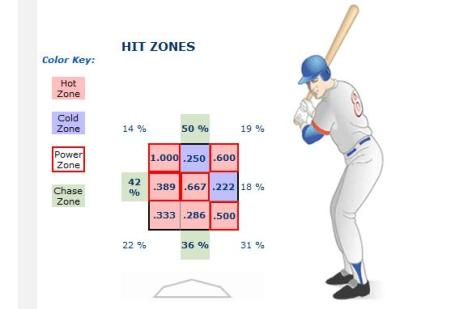
Because of his ability to handle those pitches well, opponents are now targeting other areas of the strike zone. Using the Hit Zone chart from Inside Edge, we can see that Valencia has shown only two real soft-spots in his swing so far: middle-up and middle-in. 

Danny Valencia's Hit Zones


While Orioles and Royals pitchers may have had the intentions hitting those cold spots, they routinely missed out over the plate for six straight games and Valencia revealed that he is talented enough to take advantage of those mistakes. Meanwhile, in this most recent series, the Rays pitching staff attacked those weaknesses and exploited his chase zones with total disregard for human life.
 
Tampa’s Wade Davis was virtually systematic in his approach, pounding the fastball at that middle-in locale then dropped the slider on him in his chase zones. In his first match-up, Davis buzzed a fastball in his middle-in cold zone for strike one then proceeded to throw two straight sliders in his chase zone to dispatch him in three pitches. During their fourth inning battle, Davis again started him with a fastball, this time in his outer-half chase zone (which Valencia wisely laid off) then came inside twice with the heat to induce a fly out to left. In their third and final encounter, Davis showed him a slider for a strike then burned a fastball in his elevated cold zone, getting Valencia to fly out to right.
 
Tampa Bay showed that they are an astute team that is capable of not only being aware of Valencia’s weaknesses but also have the talent to execute. This description is not too far off from how James Niemann handled him as well on Tuesday night. Ditto for rookie Jeremy Hellickson on Monday too.
 
When advanced scouts start to see something that a hitter will crush, like Valencia and fastballs, they will report back to the club quickly. Not surprising, the amount of fastballs thrown to him went from 67.4% in June to just 49.0% in July. If they start to see a tendency or a pattern, like Valencia’s middle-in soft spot or likelihood to chase, they’ll report that too. Word spreads quickly in baseball.
 
With this detailed map of how to get him out waiting for him in Cleveland and Chicago, Valencia’s next lesson in his on-going development will be to learn how to adapt to the ever-changing competition.

Sunday, August 01, 2010

OtB Twins Notes

With the non-waiver trade deadline coming to a close on Saturday, the Twins proceeded into August having made only one maneuver, trading for Nationals closer Matt Capps to fortify a bullpen that had been taxed in July. While the Twins were looking for starting pitcher, discussing left-hander Ted Lilly with the Cubs, they ultimately backed down as Chicago was seeking players that the Twins were unwilling to give up. Although Lilly has pitched much better than his depressing 3-8 record would indicate, as a fly-ball oriented pitcher, his addition to the rotation would not have played to Twins’ defensive strengths. Another target that would have plausibly fit better into the Twins’ defensive asset would have been Houston’s Brett Myers. Myers, who has continually thrown six or more innings in each start, has been impressive so far this season, throwing his slider more frequently to induce more groundballs. Word from the Twins front office in the early part of the week was that they were not considering Myers a trade candidate at all (perhaps because of personal makeup) but changed direction at the trade deadline and attempted to see what it would take to get him relayed Joe Christenson. However, the Astros apparently valued Myers immensely as on Sunday Houston extended Myers through 2013.
One of the most obvious reasons Capps was sought out over Toronto’s Scott Downs or Jason Frasor or other late inning relief candidates is Capps ability to consistently pound the strike zone. The Twins’ demand of command not only out of their starters but out of their bullpen as well. The team’s relief arms have issued the fewest walks in baseball (81) and have the lowest BB/9 in the American League (2.57). To his credit, Capp’s current total (9) is tied for sixth while his BB/9 (1.57) is the tenth lowest in baseball making his style a very good fit for the organization’s philosophy.

Fox Sports writer/reporter/shorter than Adam Wainwright Ken Rosenthal believes that the Twins may be a potential team to pursue Red Sox third baseman Mike Lowell. While this may have seemed plausible in June, the times have changed for the Twins and the need for someone like Lowell as dissipated. In addition to injuries and drop off in production outside of Fenway, there is another big reason the Twins should not have that much interest in Lowell: Since July 1st, Danny Valencia has now gone 28-for-59 (.474) with 13 runs batted in. Only twice in the month of July did he fail to record a hit in a game. With his right-handed stick in the lineup, the Twins now have three right-handed forces (Valencia, Delmon Young and Michael Cuddyer) to subdue left-handed pitching.

While his defense comes into question, Denard Span has slowly improved his numbers since the beginning of the season. According to John Dewan’s Plus/Minus system, Span is now the fourth-best defensive center fielder in the American League (+8). This certainly helps lift the Twins from the position of having the worst outfield in baseball. The Twins’ outfielders have managed to track down just 133 balls out of zone, the third-worst in the American League, which helps explain why the pitching staff is the owner of a .167 BABIP on fly balls, 20 points higher than the AL average of .142.

Since the All Star Break, Francisco Liriano has thrown 21 innings, racking up a 3-0 record with a solid 25/6 K/BB ratio and has yet to relinquished a run. Yes, this sort of output should have been expected.

Speaking of Liriano, him and Carl Pavano’s 42% of off-speed pitches chases out of the zone lead the American League in that category (average 30%). They have filthy stuff.

For the season, Delmon Young has a .376 batting average on fastballs, the third best in baseball. Not surprising, coinciding with his murder-death-kill of American League pitching, his amount of heaters has decreased dramatically. In June, 56.1% of his pitches seen were of the fastball variety. In July, a month in which Young hit a massive.434/.455/.736, he was thrown fastballs just 39.9% of the time - by far the least frequent in baseball. This is just another sign that Young has been adjusting with the pitchers that have tried to adjust to him.

If you have $2.99 million lying around (like most people), you can purchase Brad Radke’s Greenwood, MN home on Lake Minnetonka. If you do happen to buy the house, the real estate company would like you to know that the house usually settles in during the third inning.