Friday, August 14, 2009

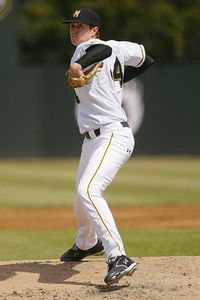
Gibson.

With three days remaining in the signing period for the amateur draft picks, the Twins are placing themselves in a position to lose their first number one pick since Travis Lee in 1996.  Kyle Gibson, the right-handed pitcher out of the University of Missouri, has requested a bonus of near $2.5 million – well above the MLB slot recommendation of $1.287 (a ten percent decrease from 2008) – based upon a outstanding college track record and a high Baseball America ranking.  The Twins’ offer is supposedly $1 million short of Gibson’s request as the organization has valid concerns regarding his injury history.  While Gibson certainly has talent, the Twins have what should be viewed as legitimate apprehension to schilling out that money.
 

In December 2008, well before the release of his injury, Driveline Mechanics deconstructed Gibson’s delivery.  Using this video segment of Gibson pitching in the Cape Cod League in 2007, Kyle Boddy of DM.com identified several problematic areas in his mechanics; the first of which is less troubling then the other two.  Because of Gibson’s tall, lanky frame, he’s got an enormous distance to cover in his stride – a step that takes just shy over an eternity.  Boddy focuses in on the leg-lift itself which, as he notes, is borderline worthless.  This has been echoed in several different scouting forums and it provides insight to Baseball America’s lone criticism of Gibson was that he was unable to generate more velocity during his three-year tenure in the Show-Me-State: he’s throwing all arm (a problem I’ll address in a minute).  From a developmental standpoint, it would seem that Gibson still has velocity yet to be milked out of him.  Gibson’s motion of raising his long leg in to a very solid balance point is good; however, instead of driving towards the plate, Gibson lowers his leg then starts his push towards home – minimizing hip force.  Why is that a problem?  It puts added exertion on his arm.  


The arm, of course, is a huge fixation when projecting Gibson.  Prior to June when it was made known of his forearm fracture, Gibson was touted as a top five and certainly a top ten pick in the 2009 draft.  The news of the arm injury naturally caused many teams to recoil in doubt.  Forearm stress fractures are typically results of repetitive flexion-extensions (flexing-straightening) of the elbow or pronation-supination (inner-outer movement) of the wrists.  Reviewing the footage of Gibson’s arm motion, Boddy finds that there is plenty of evidence of this.  Highlighting his loading process, Boddy notes that his elbow at this position comes to a point of near hyperabduction.  While his scapula loading (or “scap loading” which is the act of bringing your arm/elbow to shoulder height and then pulling the elbow back towards the shoulder) might not be as violent as say, Brandon McCarthy, this motion is a forced one – causing undue stress on the shoulder and elbow joints.  Although it might not be the source of his forearm stress fracture (I would suspect that might have to do with his plus-slider that he would have been throwing with his upper-body), Gibson’s mechanics will need some re-evaluation in the lower-levels unless the Twins want to flirt with more injuries.   


Oddly enough, Gibson told Alex Halsted in his recent interview that he is most like the Tigers’ Justin Verlander – who was a similarly tall, thin, hard-throwing, right-handed collegiate draft pick.  Unfortunately, that’s about where the similarities end.  Gibson claimed that he is like the Detroit pitcher in that he “allows his body to work with his arm.”  This may be a simple case of terrible self-awareness or an ingenious PR push at the signing deadline but my guess is that it is the former.  It is true that Verlander generates a substantial amount of velocity from a hip-heavy motion and while he shares a high leg kick with Gibson, Verlander uses this height to propel his body forward thus creating less effort on his arm.  Gibson certainly does not share this trait.  Furthermore, Joe Christensen’s blog re-posting of the quote only tossed more chum in the water for disgruntled Twins fans who subsequently littered the comments section with scathing words for the franchise that would choose to pass on the next Verlander.   


Yes, Gibson’s 6’6” frame allowed for unbelievable projectability and his lower portion of his body could probably be corrected in rookie ball but his right-handed delivery mechanism might already be beyond damaged coupled with the time commitment to overhaul his mechanics and it is decisively tougher to open the checkbook.  Spending what Christensen reported was a desired income of $2.5 million suddenly seems like a foolish investment.  The Twins scouting department gambled on Gibson’s projectability and wagered that he would be more accommodating to sign for the current MLB slot recommendation considering all of the factors which caused his stock to sink.  The organization probably figured they could outfit him with new mechanics and teach him to throw a change-up thereby transforming him into a top-of-the-rotation pitcher or, at minimum, a solid relief arm.  Meanwhile Gibson, like every other red-blooded American, believes he should be paid what he are worth – and Gibson had been told his value was of a top five pedigree. 


It is quite the contradiction, as Twins minor league prospect guru, Seth Stohs, noted in a recent conversation, the Twins spent time telling him how desirable he was to the organization then when it comes down to dollars and cents, they retract their message.  We like you, just not as much as you think you deserve.   It is a hard truth of the business on both sides. 


Monday, August 10, 2009

What Is Wrong With Perk?

Twice now in a little over two weeks, Glen Perkins’s shoulder is the subject of medical attention.  This time, the Twins lefty and his agent, John Courtright of SFX, took matters into their own hands and elected to seek out an MRI.  Judging by the organization’s mishandling of pitching injuries, I’d say their request is justified. 

Perkins cited his decrease in velocity (which declined from an average of 91-mph in April to 89-mph since July 22nd) as Exhibit A and the inability to keep the ball down in the zone as Exhibit B.  The loss of velocity is often a symptom of shoulder ailments and sometimes a prelude to a torn labrum.  Using pitchf/x charts from brookbaseball.net, there is ample evidence that his release point has dropped in his more recent starts.   This is noteworthy because if you are unable to maintain the same height of your previous arm angle/motion because of shoulder irritation, your elbow will naturally lower along with the rest of your arm.  A lowered elbow translates into higher pitches.  This makes perfect sense when you consider that since his July 22nd start, Perkins has allowed five home runs and an opponent slugging percentage of .694 in 13 innings.

There is a high probability that Perkins has ruptured a portion of his supraspinatus resulting in the inflammation of the shoulder (i.e., tendonitis).  This would explain the rather mild-sounding discomfort that Perkins complained of which “felt like I rolled out of bed and went out on the mound."  Perkins explained this sensation the same way every college student starts there day.  A torn labrum, on the other hand, is more frequently described as repeated muscle tearing from bone when the arm is lifted overhead -- hardly a pain experience that one would compare to rising in the morning from their Sleep Number.  The good news is that it is probably not a torn labrum.  While not completely a career-killer, labrum tears and the long road of rehabilitation post-surgery produce a small percentage of pitchers who return successfully.  Far too often pitchers return from the tear repairs to a noticeable decrease to their velocity or are forced to alter their mechanics which leads to a higher re-injury risk and/or less effectiveness (Jesse Crain comes to mind). 

Kelly Theiser highlighted Perkins’s diagnosis from Dr Lewis Yocum after a visit following his one-inning debacle in Oakland in which the specialist ruled it a case of tendonitis.  Dr Yocum, as you may have deduced, is, as it was so eloquently put in Anchorman when describing Ron Burgundy, the balls.  Aside from Perkins, Yocum has welcomed the Indians’ Jake Westbrook, the Mariners’ Erik Bedard, the Nationals’ Jordan Zimmermann, the Orioles’ Rich Hill, and the Angels’ Scot Shields since the beginning of the month.  His client list is nearly bottomless.  If you have arm troubles, you see Yocum.   So the verdict was that Perkins was suffering from “slight” tendonitis in his shoulder would appear to be an easily acceptable diagnosis and most likely be treated with rest and prescribed non-steroidal anti-inflammatory pills. 

Tendonitis, of course, is a byproduct of overuse.  The easiest fix for shoulder tendonitis would be rest, anti-inflammatory medication and monitoring of a pitcher’s workload once he bounces back.  Combine the fact that he had a history of overexertion (he threw 185 innings in 2008 after tossing just 28 in 2007), it would be reasonable expectation to throttle down on the lefty by skipping a start or two.  Unfortunately, starting pitchers in the midst of a pennant race do not have the luxury of using PTO and are often “cleared” to throw again and pushed back on to the mound.   So instead of withholding Perkins from his next scheduled start the Twins had him throw 102-pitches five days later against the visiting White Sox. 

This raises a whole other concern on a global-level for the organization and it is disturbing in its own right.  In addition to not skipping Perkins, manager Ron Gardenhire tossed out rather skeptical remarks regarding the MRI saying "I'm not going to question [the decision for the MRI]. If that's what they want to do, do it and then see where we're at. I'm all for it if they feel something might be wrong, to make sure it's not. To make sure he's OK and go from there."  Obviously without Kevin Slowey available and Francisco Liriano ineffective, the Twins and their manager were nervous about the possibility of using rookies Anthony Swarzak and Brian Duensing liberally without having to subtract Perkins.  Nevertheless, pushing him when his shoulder has injury potential is downright dangerous.

The Minnesota Twins have long been painted as a “cheap” and “frugal” organization, however, with the medical bills association with arm injuries to Francisco Liriano, Boof Bonser, Pat Neshek, Jesse Crain and now Perkins (among others within the system), it would seem that the team could save a few pennies each year by implementing further preventative practices. 


Sunday, August 09, 2009

The Pavano Acquisition.

With some reason, there exists a chorus of local media wonks that believe that Carl Pavano was less than a resounding acquisition for the Twins.  They will say that securing another aging, control-wielding pitcher that was passed over by the larger market teams at the trade deadline reeked of a “typical Twins” maneuver.  On the airwaves, KFAN’s Paul Allen recited how uninspiring this move was to a choir of uninformed rubes.   Yes, those that worship at gospel of ERA will be less enthused by the Pavano trade; however, there are plenty of reasons why this acquisition should be met with the same victorious reception as if the Twins landed either Cliff Lee or Jarrod Washburn.  In fact, there could be MORE reasons to be excited about Pavano. 

 
Littered with a history of more injuries than Wile E. Coyote, Pavano figured out a way to extort $39.95 million from George Steinbrenner while working just 26 days out of four years.   (Good work if you can find it.)  Back when the Yankees signed the then 28-year-old Pavano in December of 2004, they figured they had acquired a potential 20-game winner that had World Series experience and would be another frontline component of a dominating rotation that already boasted Randy Johnson, Mike Mussina and Kevin Brown.  Little did the Yankees know he would pull an Ocean’s Eleven on Steinbrenner’s money.  Pavano would never give New York a full season of starts in his four years in the Bronx, rather he would cost the organization millions in medical expenses and headaches. 

Though he may not be able to find a cab in NYC any time soon, Pavano rebounded nicely in 2009, appearing to be fully recovered.  In January, the Indians inked the tall righty to a one-year incentive-laden deal that started with a $1.5 million base but could increase by another $5.3 million as various milestones are reached (starts and innings).  Finding themselves as an also-ran in the Central and staring a $16 million dollar operational deficit in the face, the Indians began to jettison anything that could float.  Gone were Lee, Victor Martinez, Mark DeRosa, Rafael Betancourt and Ben Francisco.  Oddly enough, Pavano remained.  As attractive as Roy Halladay, Lee and Washburn were made out to be at the trade deadline, rare were reports of how adding Pavano could upgrade a rotation.  Perhaps it was the gaudy ERA or the looming injury potential, but no deal involving Pavano was made by the July 31st deadline, possibly to a great baseball injustice to the Indians organization and a huge coup for the Twins.   

For teams that evaluates players with advanced statistics (Boston, Tampa and Seattle come to mind), it would be hard to ignore that his xFIP of 4.16 – a stat that normalizes the home run rate along with the infusion of strikeout and walk rates – which was TENTH best in the AL among qualified starters.  Better than Sabathia.  Better than Buerhle, Shields, Washburn, Burnett.   Et cetera.  Et Cetera.   He was pitching better than all of those staff aces.  One xFIP point worse than Lee – one point! – and it took the Phillies four of their top ten prospects to nab Lee from the Indians.

From his perspective, Pavano did everything he could to limit the number of guys on the basepaths.  With 1.7 walks per nine innings, Pavano was second only to the highly-coveted Halladay in walks.  Similarly, Pavano’s 67 percent first-pitch strike trailed only the Blue Jays’ ace as well.  His ERA over-5.00 is reflective of a largely unlucky series of events and the results of what happens once the ball was in play, which was out of his control.  While Washburn’s peripheral numbers are nothing to write home about, the Mariners supplied the flyball-oriented pitcher with some of the best fly-catchers in the game today in the Safeco outfield.  As Washburn’s trade value with inflated by his surroundings and his ERA substantially lowered in 2009 by the aid of his defense, Pavano was wrongly demerited for the sins of his defense.  Over the course of his career Pavano’s use of speed change between his fastball and changeup (10-mph velocity difference) coupled with the downward action of his split-finger tended to incite a higher number of groundballs than average.  Because of the Indians foolish insistence on using Jhonny Peralta at shortstop, it wound up costing the Tribe and Pavano numerous outs – evident by the team’s fourth-worst .770 infield revised zone rating leading to a higher average on those groundballs in play (.275 versus the league average of .233).  A defensive infield unit closer to that of the league average RZR of .783 would have saved the righty a good deal of baserunners.  
Furthermore, Pavano maintained a DER (defensive efficiency ratio) of .673 – the third lowest amount of balls converted to outs among qualified starters.  Because of Cleveland’s inability to exchange balls in play for outs at the going rate of .695, Pavano was forced to throw more pitches, leading to more opportunities for the opposition to drive a pitch. 
This is hardly giving Pavano the tools to succeed.  Whereas Washburn’s defense provided him with additional outs and quicker exits to the inning, this prolonged time on the hill came at the expense of more baserunners crossing the plate.  Pavano’s extra exposure resulted in more runs trickling in as he exercised the AL lowest strand rate of 63.4 percent while the average starting pitcher was able to strand 71.4 percent of all runners.  Part of that low number has to do with who Indians manager Eric Wedge relays the ball to once Pavano is pulled.  With 41 percent of inherited runners scored, Cleveland’s bullpen is the second-worst in the AL.   This is a considerable amount of bad luck interjecting itself into an otherwise solid pitcher. 

But the simplest reason to get behind this transaction is the fact that Pavano has been dominant against the two AL Central teams competing with the Twins.  For seven innings on Saturday night, the right-hander demonstrated exactly why the Twins were interested in his services.  Holding the Tigers to no runs on five hits, Pavano improved his 2009 record against Detroit to 4-0 with a 1.48 ERA in 30.1 innings.  Make that now 6-1 against the Tigers and White Sox combined.  Considering that there are 13 more matches against these opponents, there will be a good chance that Pavano works three to four of those games.  


Wednesday, August 05, 2009

Keppel.

When Bobby Keppel was called up from Rochester on June 24th, the Twins were in need of a reliever that could produce at a sustainable pace.  Luis Ayala, the touted "groundball" pitcher, failed to do so and drew the ire of Ron Gardenhire by leaving too many sliders up in the zone.  As replacement level-type pitcher getting groundballs at a 51 percent clip in AAA, Keppel would be a suitable and inexpensive gamble to supplant Ayala in the bullpen. 
 
From June 27th to July 19th, Keppel had pitched in seven game, thrown 16 inning while allowing one earned run on just eight hits along with a 0.57 GB/FB rate.  The right-hander appeared every bit the answer.  Yet after July 19th, Keppel would work in seven more games and allowing 12 earned runs on 17 hits with a nasty 7/2 BB/K ratio.  Put simply, Keppel was getting smashed up in the zone, an area he rarely entered in his first seven outings.
 
Trajectory | Strike Zone Plots
 
June 27, 2009 versus Cardinals
 
On June 27th, Gardenhire turned to Keppel to maintain the Twins 5-3 deficit against St Louis to two runs.  Keppel pitched admirably, surrendering a leadoff triple to Joe Thurston in his first MLB appearance since 2007, but held the Cardinals scoreless while pitching the fourth through the seventh.  True to his form, Keppel got seven of his 11 balls in play to be hit on the ground. Location was Keppel's saving grace.  By keeping the ball down in the zone (under the two-foot line on average) and away from the middle of the strike zone, hitters were forced to beat the ball into the dirt.  His fastball's velocity was averaging 94.0-mph on that June 27th game as he peppered in a biting slider as well. 


June 30th, 2009 versus Royals

His next outing in Kansas City on June 30th was much the same.  In his 2 1/3 innings of work, Keppel recorded four groundballs on five in play and struck out three batters.  His fastball had slowed a bit (93.5-mph) but he kept it at the knees or lower to avoid heavy contact: 


July 28th, 2009 versus White Sox
 
The All Star break interrupted Keppel's feelgood storyline.  When baseball resumed, Keppel struggled mightily as his pitches began to ascend in the zone and his sinking fastball was no longer knee-height (nor was the velocity closer to the mid-90s range).  On July 28th, Keppel was summoned to face the Chicago White Sox in the eighth inning.  His fastball, now averaging out at 93.2, is not thrown in the lower half of the zone but rather is sneaking up towards the middle of the plate -- an area that is more readily driven across the ballpark. 


July 31st, 2009 versus Angels
 
Following a nine-pitch outing on July 31st against Los Angeles, Keppel returned the following night.  With the Angels ahead six-to-four, Gardenhire turned to Keppel following RA Dickey's 2 2/3 inning effort.  Keppel rewarded his manager's decision by surrendering back-to-back home runs to Juan Riviera and Kendry Morales.  The right-hander would settle in and work 2 2/3 innings himself, allowing the two home runs but would give up six flyballs to his five grounders.  On top of that, his fastball's velocity would drop to an average of 91.7-mph - 2.3-mph slower and an additional .013-seconds to the plate. 


August 4th, 2009 versus Indians
 
On Tuesday night in Cleveland, with the Twins cruising to a 10-0 victory, Keppel was given the task of escorting Scott Baker's shut-out through the ninth inning.  Although his velocity returned (93-mph plus on average), Keppel labored to keep the ball down.  Jhonny Peralta doubled followed by a Travis Hafner single to end the scoreless drought.  Both pitches were up in the strike zone. 


Release Points

The natural inclination when something is wrong with location is to instinctually look at the release points and see if something has changed.  According to his release plots - arranged oldest to newest - we see that his point of release has shifted above six feet in height. This is an indication that his arm is straighter upon release and potentially causing less downward movement as a result.  The alteration could be related to Keppel attempting to aim the pitches rather than throw with his fluid motion but another hypothesis could envolved this being a product of arm fatigue.  After all, his velocity changed significantly between outings.   


Monday, August 03, 2009

OtB Twins Notes (08.03.09)

In the Los Angeles Angels' farewell tour of the Metrodome, the Twins were outscored 35-15.  LA Times beat writer, Mike DiGiovanna, provides some of his more memorable moments while covering the Halos in the Dome.  Writes DiGiovanna of the facility: "It just has no charm. The grass is plastic, the roof is sometimes impossible to find fly balls in, and the building has no real distinguishing characteristics. It's basically a football stadium the Twins happen to play baseball in. There is nothing aesthetically pleasing about it. About the only thing good you can say about the place is that it's not quite as depressing as the old Kingdome in Seattle."
 
Following the dismantling of the pitching staff, Joe Christensen suggested a few arms that maybe available in the weeks leading up to the waiver deadline of August 31st.  On the list are Arizona's Jon Garland and Doug Davis, San Deigo's Kevin Correia and Seattle's Miguel Batista.  Batista has little control (5.15 BB/9), Correia has been better with the addition of a slider and, judging by the Cla Meredith trade, the Padres have not figured out what market-value means and Garland has been in steady decline.  Davis is the only one among the group that appears to be the most intriguing. 
 
Speaking of Meredith, since the Orioles acquired him, he has thrown 5.2 innings, struckout five and walk none while giving up just one earned run during Boston's 18-10 assult on Baltimore.  Are you telling me we did not have a spare utility player lying around?
 
Sometimes an All Star break can be too relaxing.  Since returning from the hiatus, Bobby Keppel has pitched 10 innings and allowed 11 earned runs (9.90 ERA) on three home runs and an opponant slugging percentage of .619. 
 
Sid Hartman says that former Twins pitcher and radio broadcaster Jack Morris believes this Twins pitching staff (27.6 avg years old -3rd in AL) needs an infusion of veteran talent if it plans on reaching the next level.  The Twins attempted to bring in Jarrod Washburn at the trade deadline before Detroit acquired him from Seattle but, by Hartman's account, the Mariners requested Glen Perkins in exchange for Washburn and the Twins flat-out refused.  Take that with a grain of salt because, as John Bonnes noted, Hartman essentially fabricated the entire Sanchez-for-Liriano trade rumor a few weeks ago.
 
Here's an example of the recent acquired Orlando Cabrera providing one of those veteran "intangibles".  During his pregame, welcome-to-the-team interview Cabrera proceeded to answer the first question in his native tongue -- probably to the dismay of the mostly Midwestern born-raised Twins beat writers.   The shortstop smiled and quipped, "They told me you guys speak Spanish." 
 
Even though Cabrera might not be the long-term answer for short, Tyler Ladendorf represents a prospect that has the raw tools but has yet to demonstrate that he is capable of moving up the organization's ladder at a rapid pace, and in that context, he's not such a hefty ransom.  At 21 years old and still unable to figure out low-A pitching in the Midwest League, shortstop Ladendorf was far from the high caliber prospect the Twins thought they had when they drafted him in the second round in 2008 and signed him to a nearly $700K bonus.  As Baseball America notes "The toolsy Ladendorf, 21, has been a disappointment thus far in his pro career. The righthanded batter was hitting 233/.292/.267 in his first 60 at-bats for low Class A Beloit, having spent most of the season in extended spring training and then tearing up the Appalachian League for 15 games."
 
In order to clear room for Cabrera, the Twins sent Brian Buscher to AAA Rochester.  Buscher's role as a left-handed pinch hitter never fully materialized, but the 28-year-old did go 3-for-13 (.231) while drawing walks in 6 of 20 pinch hitting plate appearances leading to a .500 on-base percentage.  Despite having his best month of the entire year (9-for-28, .321 BA, .406 OBP), Buscher had options remaining and providing the least flexibility among role player so it seemed obvious that he would be the one demoted.   Rochester still has to make a roster move to make room for the incoming third baseman.
 
Kelsie Smith notes that the loud noise Justin Morneau made urging the Twins to add an impact player at the trade deadline came at the expense of having Buscher, a close friend of Morneau's, sent to Rochester.  Subtle jab back at the clubhouse from the front office?  According to Smith, Ron Gardenhire said prior to the decision to move Buscher, "Sometimes it's be careful what you ask for with players, though, too, huh? We'll see. We'll see how it all works out." 
 
La Velle E Neal reports that Francisco Liriano threw in a bullpen session on Sunday.  Feeling fine, Liriano plans to start on Wednesday against the Cleveland Indians.  By the way, Liriano leads the MLB with 16 four-pitch walks.
 
Bill Smith has seemingly distanced himself from the actual decision-making responsibilities.  Patrick Reusse provides details of Smith's post-trade press conference in which the Twins GM noted the difference between the way he operates and how the former regime did.  "I'm an administrator; Terry's an evaluator," Smith said. "When it was time to make a decision, Terry listened to his assistants but relied on his evaluation. Those decisions are now reached more by consensus."  So, whereas Ryan would accept accountability, Smith is suggesting that the buck stops there, that guy over there and three office door's down the hall as well. 
 
The 16-year-old German prospect Max Kepler-Rozycki, whom the Twins signed for $800K, suffered a foot injury in the Bavarian championship a few weeks ago and has been on crutches and will not play in the European Championships this month.

Interesting piece in the Wall Street Journal on Dan Okrent who pioneered a new stat in 1979 called IPRAT or "Innings Pitched Ratio".  This would later be known as WHIP, as it is the measurement for walks plus hits divided by the amount of innings pitched.  Okrent, who authored one of the better baseball books on my bookshelf called "9 Innings", came up with this statistic to add to his new creation, 'Rotisserie' baseball, which was a precursor for the millions of fantasy baseball leagues.  Since the proliferation of the WHIP statistic, researchers found a strong correlation to it and future performance of a pitcher.  Despite the predictable parallels, teams, such as the Tampa Bay Rays, shy away from using it as a evaluator.  Says Dan Feinstein, director of baseball operations for the Rays “Once a ball is hit, the pitcher has no control over the outcome of the play, with the exception of the home run. There are too many factors that determine whether or not that ball will be a hit, including ballpark size and dimension, positioning of the defense and ability of his defenders.”
 
Which is why some put emphasis on another metric: expected FIP or xFIP.  The Royals' statistical minded starting pitcher Brian Bannister tells Bob Dutton that “I think the ultimate stat for a pitcher is xFIP,” Bannister said before pausing and offering a wry grin. “I know that’s getting really technical. It’s fielder independent pitching adjusted for your home-run rate back to the league average. That shows a pitcher’s true level of talent. Baseball doesn’t have a strength-of-schedule element like college football does.”  Using the xFIP metric, the top Twins starters are:

Pitcher

xFIP

S. Baker

4.10

K. Slowey

4.39

F. Liriano

4.57

G. Perkins

4.94

N. Blackburn

4.96

A. Swarzak

5.30

 
Josh Johnson has a July review of the organization's minor league system.
 
Back in March, I did a Player Profile at Baseball Digest on former Twins closer Doug CorbettCharley Walters informs us that Corbett is now a high school guidance counselor in Jacksonville, FL.  
  
What was Ron Gardenhire like back in Okmulgee High School in Oklahoma?  Mike Baldwin says pretty "low key".